Equity-Pulse

Equity-Pulse

Your Weekly Dividend & Options Playbook

Disclaimer

Equity-Pulse content is for informational purposes only and not financial advice. Investments carry risk, including loss of principal. Always do your own research and consult a professional before acting.

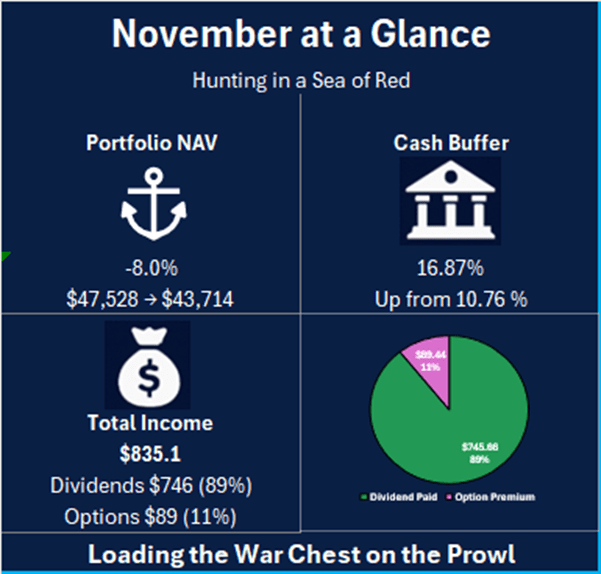
  • Month 14 Snapshot: The Hunt for Red October

    November Snapshot

    Net Asset Value
    $43,714
    📉 Down 8.0% (from $47,528)
    💰 Dividends
    $745.66
    Options
    $89.44
    🛡️
    Cash Reserve
    16.87%
    ↑ Up from 10.8%
    ❄️
    Market Mood
    Crypto Winter Fears & Tech Rotation

    November started with a pullback across the portfolio. The drop was not large, but it was clear enough to show that the strong momentum from October had weakened. Markets turned softer, volatility settled, and a few high beta positions that had been climbing earlier in the year finally cooled. After a lively Uptober, this was a simple reminder that markets do not move in straight lines.

    Red months tend to be more revealing than green ones. They show which parts of a strategy can hold steady and which parts were leaning too much on good conditions. November made it clear that some positions were sized a little too boldly while volatility was high, and once the environment shifted, it showed up quickly in the results.

    The drawdown stayed within a normal range, although faster adjustments could have reduced some of the decline. Even so, the foundation of the portfolio stayed firm. Income continued to arrive each week and the cash reserve grew, which helped soften the overall impact.

    The main lesson is simple. The challenge was not the softer market. It was assuming that volatility would stay elevated for longer and reacting a little too slowly when it began to fade. November served as a useful reset. It highlighted the need for steadier sizing, firmer discipline, and timely adjustments as the portfolio moves into its next stage.

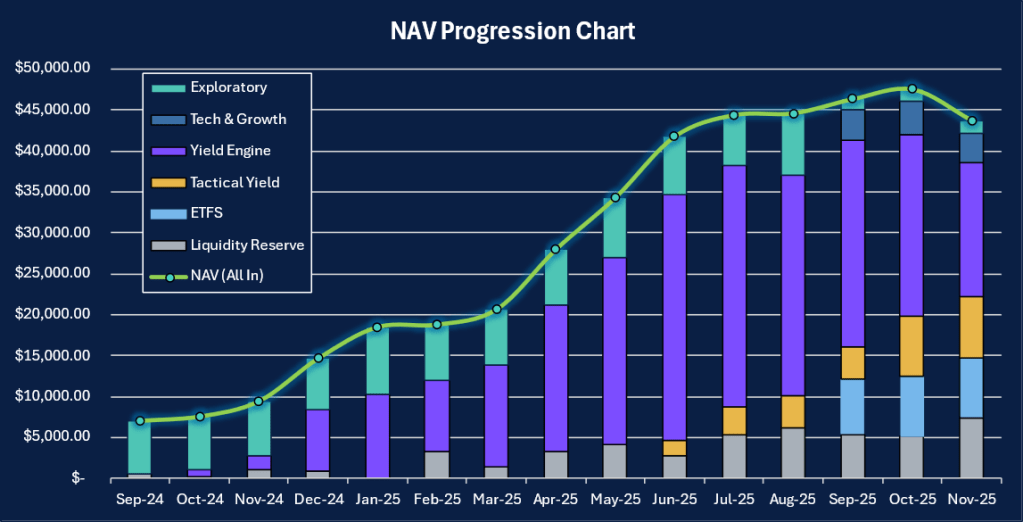
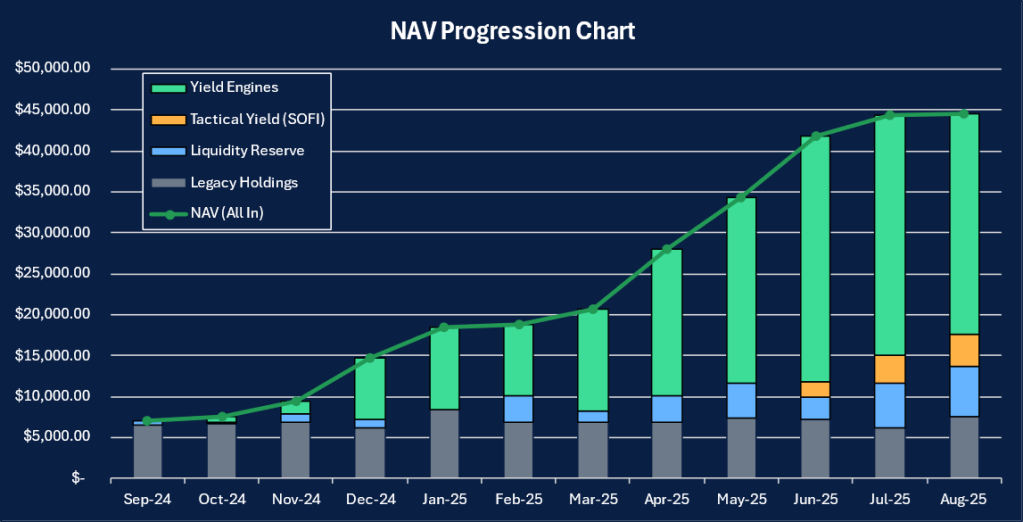
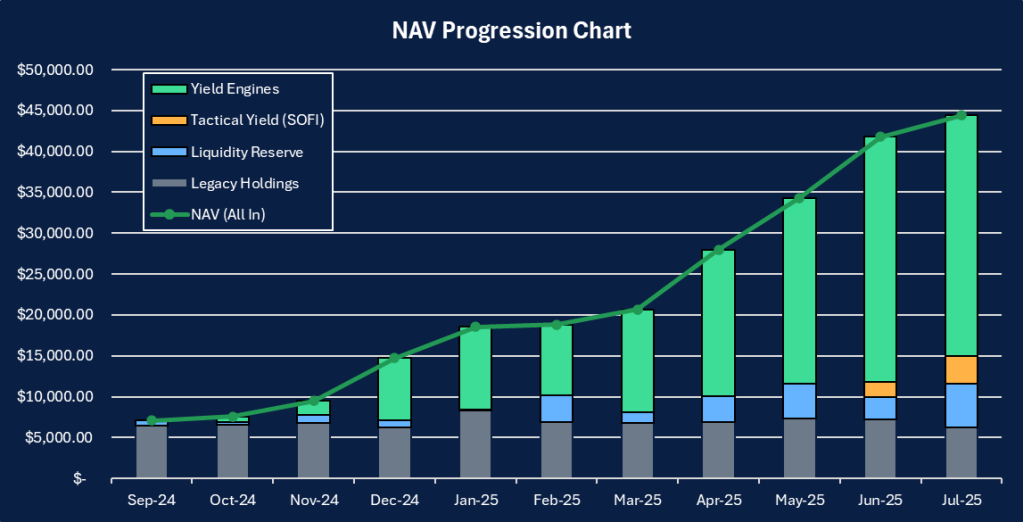
    The steady climb of the past quarter met a clear pause in November. The portfolio closed the month at $43,714, an 8.0% pullback from October’s peak. On the chart, this drop ends a four-month stretch of gains and brings Net Asset Value back to levels last seen in late August.

    The shift becomes clearer when viewed through the asset breakdown. October’s high was supported by strong volatility, firm crypto sentiment, and an expanding Yield Engine. As these conditions eased in November, the Yield Engine gave back more than $5,500. Most of the contraction came from the cooling in crypto linked exposures and high beta positions. Tech and growth names softened as well, which added to the decline.

    The Liquidity Reserve moved in the opposite direction. The increase came from two sources. First, weekly income from dividends and option premiums was kept in cash instead of being redeployed. Second, the monthly cash deposit for November was added directly to the reserve. Together, these pushed the cash buffer 44.0% higher than the month before.

    The overall picture is one of adjustment, not deterioration. Value pulled back, but the capital base strengthened. Higher liquidity, reduced dependence on elevated volatility, and a clearer sense of where risk had built up. The chart reflects both sides of the month. A correction in price, and a deliberate move toward stability before the next deployment.

    • NAV Pulled Back
      The portfolio closed at $43,714, down 8.0% as crypto linked equities corrected. The structure held, but the drop reflected the sensitivity of high beta positions during a softer volatility environment.
    • Income Stepped Down
      Monthly income came in at $835, a 53.5% decline. Lower payouts from MSTY and CONY and a temporary reduction in option activity drove the decrease. Even so, the 1.9% yield on NAV remained healthy.
    • Liquidity Reserve Strengthened
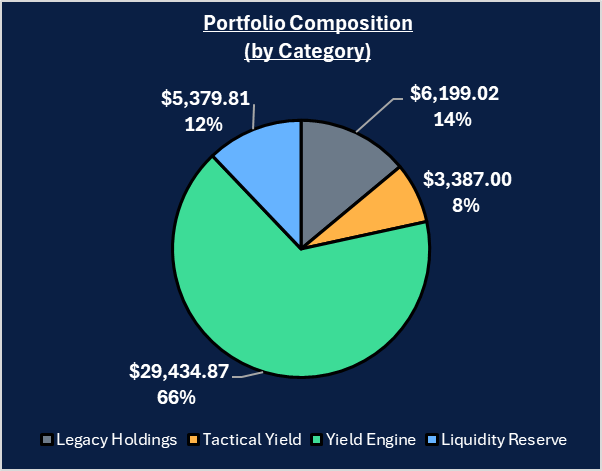
      The reserve rose to $7,374 or 16.9% of NAV. Fresh capital and unreinvested dividends lifted the buffer. With markets turning down, holding more cash was the right defensive call.
    • Yield Engine Weakened
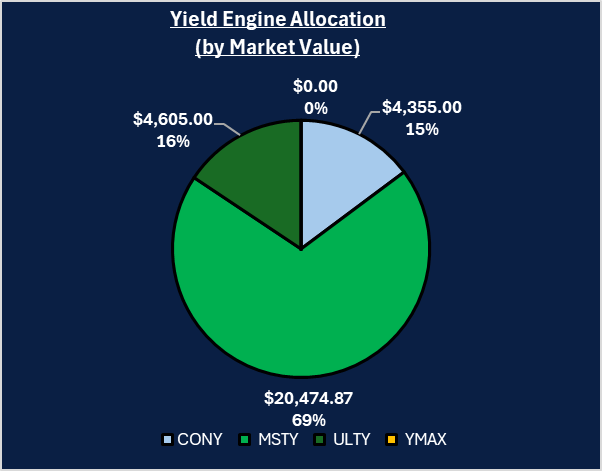
      The Yield Engine fell to $16,485 (25.2%). MSTY, CONY, and ULTY mirrored the broader crypto correction. Their upcoming reverse splits highlight how sharp the price erosion was, but they do not alter the strategy.
    • ETFs Offered Stability
      CSPX, IWDA, and VWRA ended at $7,347, essentially unchanged. This sleeve helped steady the portfolio during the drawdown.
    • Tactical Yield Stayed Productive
      SOFI finished flat at $7,430, while managed spreads still delivered nearly $90 in premiums. This sleeve continued to generate income despite muted price action.
    • Tech and Growth Cooled
      The segment fell 13.9% to $3,576, with Cloudflare and Nvidia leading the decline. The move looked like normal consolidation after earlier strength.
    • Exploratory Assets Mixed
      This sleeve closed at $1,501, up 3.2%, with gains in MetaOptics offset by losses in Luminor. The segment remains small and experimental.
    • Framework Held Steady
      November tested the Slow Hands approach. The drawdown was controlled, cash increased, and income continued. The key lesson is tighter position sizing in the Yield Engine when volatility starts to fade.

    Not everything can be explained by market conditions. November exposed a few avoidable mistakes that need to be acknowledged clearly.

    1. Mistimed Entry into MSTY
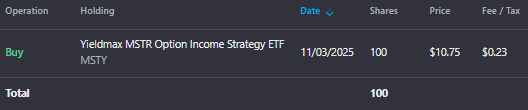
      The addition of 100 MSTY shares on 3 Nov was premature. The price was still trending down, and the correction accelerated shortly after, putting the position underwater almost immediately. The strategy behind MSTY remains valid, but a mid month consolidation or a post split entry would have offered a stronger setup.
    2. The Odd Lot Problem with 5UA
      Luminor Financial fell 15.2%, and the small position of 33 shares created an inefficient outcome. Trading fees exceed the value of the stake, turning it into a non productive holding that cannot be exited cleanly. It is a small mistake, but still a drag on flexibility.
    3. Insufficient Protection on High Beta Exposure
      The Yield Engine carried too much unhedged risk while volatility fell and Bitcoin corrected nearly 30%. SOFI was managed well, but MSTY and CONY were left fully exposed during the downturn. This oversight amplified the drawdown and highlights the need for tighter safeguards when rotating into high beta assets.

    November delivered sharp divergence across the portfolio, with each sleeve reacting differently to the broader reset.

    Yield Engine (MSTY, CONY, ULTY)
    This sleeve saw the steepest decline, ending the month at $16,485, down 25.2%. The pullback came mainly from the correction in Bitcoin, which moved from $111,000 to the low $80,000 range. MSTY fell 29.6% and CONY dropped 24.6%, reflecting their high sensitivity to crypto volatility. The exposure remains part of the long term income strategy, but the month highlighted the cost of carrying high beta positions during a volatility cooldown.

    ETFs (CSPX, IWDA, VWRA)
    The ETF base did its job. CSPX, IWDA, and VWRA finished at $7,347, essentially flat at 0.1%. While crypto linked assets swung sharply, the ETF layer provided stability and limited the overall drawdown. This sleeve continues to anchor the portfolio.

    Tactical Yield (SOFI)
    SOFI closed the month at $7,430, up 0.1%. The stability came from active spread management rather than directional gains. Nearly $90 in premiums were collected despite the quiet price action. This sleeve remains a reliable income generator when broader markets lose momentum.

    Tech & Growth
    This segment fell 13.9%, ending at $3,576. Cloudflare dropped 21.0% and Nvidia declined 12.6% as part of the rotation out of high growth and AI names. The move is viewed as normal consolidation following a strong run earlier in the year, and the positions remain structurally intact.

    Exploratory Footprint
    Results were mixed, but the sleeve finished at $1,501, up 3.2%. MetaOptics (9MT) gained 10.5%, while Luminor (5UA) fell 15.2% and remains difficult to exit cleanly due to odd lot sizing and fees. This sleeve remains small and experimental by design.

    Liquidity Managed
    The Liquidity Reserve increased 44.2% to $7,374. The rise came from fresh capital and income that was intentionally held rather than reinvested. In a declining market, this shift toward liquidity added stability and positions the portfolio for future opportunities.

    Volatility & Rates

    November began with expectations of stability. Bitcoin was projected to hold above the $100,000 level, and the broader AI narrative suggested another month of constructive volatility before liquidity thinned in December. Instead, macro conditions turned earlier than anticipated. A sharp risk off shift followed renewed volatility in US Treasury yields, softer employment indicators in the Federal Reserve’s Beige Book, and reduced global liquidity as Japan signaled a gradual move away from ultra loose policy. These developments tightened financial conditions and weakened appetite for high beta assets.

    For the portfolio, this meant stepping back from aggressive positioning. Option volatility remained elevated, which allowed the Yield Engine to continue generating income, but capital values declined. The Liquidity Reserve grew as dividends, option premiums, and new capital were held back from deployment. This preserved flexibility without chasing unstable price action.

    Crypto & Equity Performance

    Market expectations entering the month centered on Bitcoin holding its floor near $100,000 and preparing for a year end rally. Equities were expected to broaden beyond AI leaders, with fintech and small caps set to participate. That narrative reversed quickly. Bitcoin retreated from $111,000 into the low $80,000 range, pulling crypto linked equities lower. MSTY fell 29.6% and CONY declined 24.6%, reflecting their sensitivity to crypto movements. At the same time, the AI trade paused. Nvidia’s record earnings on 19 Nov triggered a sell the news reaction, signaling that strong results were already priced in. Cloudflare and other high growth names declined as capital rotated toward defensive sectors.

    The portfolio’s diversification softened the impact. ETFs remained stable and provided ballast, while SOFI held flat due to active spread management that continued to generate income despite minimal price movement. Total income reached $835 and was directed entirely into cash. The portfolio exited November with a lower NAV but a stronger liquidity foundation.

    Outlook for December

    December opens with attention focused on the Federal Reserve’s meeting scheduled for 9 to 10 Dec. Markets are pricing a high probability of a 25 basis point rate cut. If delivered, this could support a short term rebound in technology and crypto assets. If the Fed holds steady or reiterates caution, volatility may remain elevated into year end.

    The Yield Engine will also undergo structural changes. MSTY, CONY, and ULTY will complete their reverse splits in early December. These adjustments may create temporary price irregularities, so trading in these names will pause until conditions stabilize. With a larger Liquidity Reserve and clearer awareness of recent risks, the portfolio enters December positioned to respond rather than react.

    Here’s how we performed against our August targets at a glance:

    Base Goals

    Income Goal: Generate at least $1,700

    Status: ❌ Missed

    Actual: $835

    What Happened:

    Income fell well below target as the Yield Engine contracted sharply. With MSTY and CONY down more than 25%, the absolute dollar value of distributions declined. Option income also slowed due to reduced trading activity during the holiday period.

    Assessment:

    The income target did not hold under a fast drawdown. Yield output could not compensate for the shrinking capital base.


    Liquidity Reserve: Maintain 10% to 12%

    Status: ⚠️ Exceeded

    Actual: 16.87%

    What Happened:

    Cash levels rose as dividends, option income, and the monthly capital deposit were held back from deployment. Total reserves reached $7,374.

    Assessment:

    The reserve exceeded the target range, but this was a deliberate defensive choice, not an execution miss.


    Equity Exposure: Add selectively to CSPX/IWDA

    Status: ⏸️ Not executed

    What Happened:

    The ETF sleeve remained stable, but conditions were not favorable for new deployment. Liquidity was prioritized over incremental exposure.

    Assessment:

    Pausing allocation here was appropriate. Macro signals did not justify additional equity risk.


    Option Selling on SOFI: Only if put premiums exceed 2.5% of strike

    Status: ✅ Achieved

    What Happened:

    SOFI generated several option opportunities through November. You opened a short put on 14 Nov at the $26.50 strike, receiving a premium of $79.24, which exceeded the 2.5% threshold. All other put exposure was managed through buy to close orders, including the closure of the $29.00 put early in the month.

    Calls were traded separately for risk control. Two covered calls were sold on 3 Nov and 12 Nov at the $33.00 and $34.00 strikes, generating $46.16 and $54.16 in income. These were not based on the 2.5% rule and were used tactically to manage position risk.

    The remaining call and put transactions on 14 Nov were closeout legs, reducing exposure as volatility dropped. Total net option income for the month was $89.44.

    Assessment:

    Execution stayed within strategy. Put sales followed the premium rule, calls were used defensively, and overall income was generated without taking on unnecessary directional exposure.


    Yield Engine Stability: Hold and reinvest only if prices drop more than 5%

    Status: ⚠️ Mixed

    What Happened:

    The decline triggered the reinvestment condition, but the MSTY entry on 3 Nov was early. The correction accelerated immediately after the buy, placing the position into drawdown.

    Assessment:

    The rule was correct, but execution timing lagged. More patience would have improved the entry.


    Stretch Goals

    Total Income above $1,900

    Status: ❌ Missed


    NAV Growth of $1,500 to $2,000

    Status: ❌ Missed
    NAV contracted by $3,814.


    Deploy up to $1,000 into ETFs on weakness

    Status: ❌ Missed

    Deployment was cancelled to strengthen liquidity.


    Risk Management: Maintain neutral delta and avoid overexposure to crypto

    Status: ⚠️ Partial

    SOFI remained controlled, but the Yield Engine carried too much unhedged beta as volatility dropped.


    Exploratory Layer under 3% NAV

    Status: ✅ Met

    The sleeve ended at 3.4% due to NAV contraction, not new allocation. MetaOptics (9MT) gained 10.5%, supporting the hold.


    Scorecard Summary

    We fell short on growth and income goals due to the broad pullback in crypto linked and high growth assets. However, risk discipline held where it mattered. Liquidity was strengthened, SOFI was managed effectively, and exposure was not increased recklessly. The month did not meet profitability targets, but the portfolio passed a practical stress test without structural damage.

    November Transactions

    MSTY
    Bought 100 shares at $10.75 on 3 Nov.
    This addition increased the Yield Engine ahead of the anticipated volatility cycle. The timing proved early, as the crypto market corrected sharply soon after. The position remains part of the core income sleeve and will move through the reverse split in early December.

    SOFI Options
    Activity in SOFI was tactical and rule based. Put sales were executed only when premiums exceeded the 2.5% threshold. Call activity was defensive and used to manage risk, not to chase income.

    TransactActionTypeStrikePremiumNotes
    3-NovSellCall33.00$46.16Defensive call to control upside exposure
    12-NovSellCall34.00$54.16Managed within range, not tied to premium requirement
    14-NovSellPut26.50$79.24Premium exceeded threshold; primary income driver
    14-NovBuyPut29.00-$75.84Closed earlier put exposure as volatility dropped
    14-NovBuyCall33.00-$2.14Closed short call position
    14-NovBuyCall34.00-$12.14Closed second short call position

    Net Option Income: $89.44

    The put sale at $26.50 provided most of the month’s income and satisfied the premium requirement. Call transactions focused on reducing exposure as the volatility cycle shifted. The sleeve performed within strategy despite limited price movement in the underlying.

    Liquidity Reserve:
    Added approximately $2,300 of fresh capital. Rather than deploying immediately, new capital was held in reserve as markets weakened. Combined with dividends and option income, this lifted the Liquidity Reserve to 16.9% of NAV, strengthening downside protection during the correction.

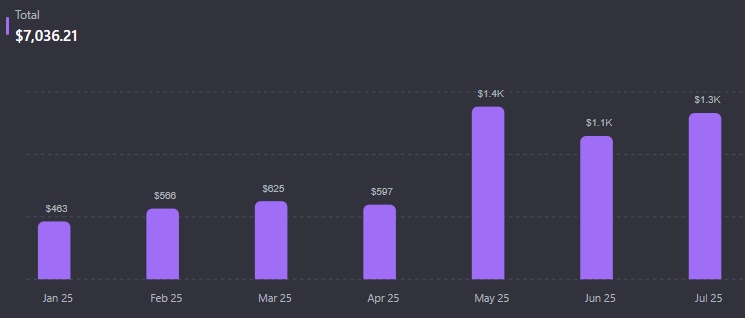
    Total income for November came in at $835.10, a 53.5% decline from October. Dividends contributed $746 or 89%, while options added $89.44 or 11%. The drop reflected the contraction in asset values and the planned reduction in trading during softer volatility conditions.

    The income mix shifted heavily toward dividends as reduced volatility and a two-week trading pause limited option activity. Despite the contraction, income generation continued and the portfolio maintained positive cash inflow through a difficult month.

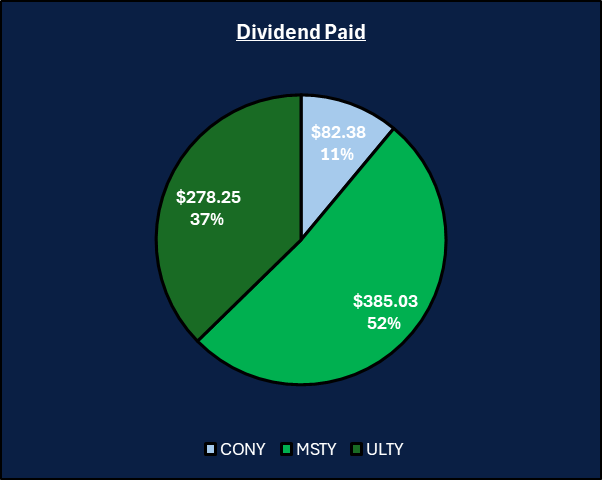
    Dividend Highlights ($746)

    Dividend output declined as the Yield Engine corrected, but distributions remained consistent relative to the reduced base.

    • MSTY: $385.03
    • ULTY: $278.25
    • CONY: $82.38

    These payouts supported the expansion of the Liquidity Reserve despite the broader drawdown.
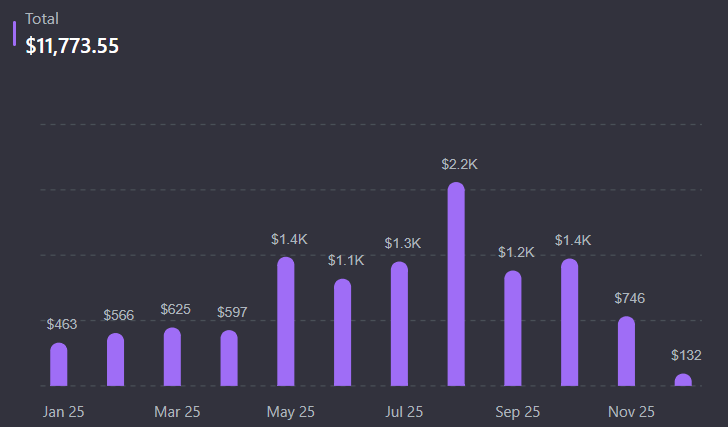
    Dividend output fell in line with asset prices as MSTY and CONY declined by roughly 25 to 30 percent. Distributions remained consistent relative to their reduced base values.

    Option Activity ($89)

    All option income came from SOFI. Activity was selective and followed the premium rule for put sales.

    • Early Month
      • Sold calls at $33.00 and $34.00 to harvest available premium.
    • Mid Month
      • Closed both calls on 14 Nov.
      • Closed the $29.00 put to reduce exposure.
      • Sold the $26.50 put, which met the 2.5% premium threshold and generated most of the month’s income.
    • Outcome
      • The sequence produced $89.44 in net income. Execution remained disciplined and avoided unnecessary directional exposure.

    Yield Profile

    • Overall Yield: 1.9 %
    • Dividends: 1.7 %
    • Options: 0.2 %

    The decline in overall yield reflects November’s volatility contraction and reduced option flow. Even so, the portfolio continued to generate steady income through dividends, supported by disciplined position management.

    We enter December with a defensive posture but an offensive mindset. The goal is to stabilize the portfolio while preparing for selective redeployment when conditions improve.

    Area of Focus

    • Monitor the Reverse Splits
      MSTY, CONY, and ULTY will complete their reverse splits in early December. MSTY will consolidate at a 1 : 5 ratio. We will wait for these adjustments to settle before adding exposure, as liquidity often becomes erratic around corporate actions.
    • Deploy Cash (Conditional)
      The portfolio holds more than $7,300 in dry powder. Deployment will remain conditional on crypto stability.
      • If Bitcoin holds support at $90,000 for three consecutive days, we will begin averaging into MSTY to lower the cost basis.
      • If Bitcoin breaks below $85,000, the Liquidity Reserve remains untouched.
    • Contain the Zombie Position
      Luminor Financial (5UA) will be classified as a zombie holding. The odd lot size and high exit fees prevent a clean unwind, so it will no longer influence active strategy decisions. It remains in the portfolio only as a reminder of the importance of liquidity and position sizing.
    • December Income Target
      With the portfolio reset lower, the focus shifts to rebuilding income. The target for December is to reclaim the $1,000 level by taking advantage of the typically higher volatility premiums that accompany year end positioning. Execution will remain selective and rule based.

    Base Target

    • Income Goal: Generate at least $1,000
      November closed at $835, below the four digit target due to the price decline across the Yield Engine. Restoring income above $1,000 is the primary objective for December. This stabilizes monthly cash flow and supports the rebuilding of NAV.
    • Deploy capital to reach ~14% of NAV
      The Liquidity Reserve sits at 16.9% of NAV. The goal is to rebalance this toward 14% through a mix of earned income and selective deployments. The expected outcome is an NAV increase of $1,500 to $2,000, driven by normalized income and cautious reinforcement of the ETF base.
    • Strategic Deployment:
      Deployment remains conditional. If Bitcoin holds $90,000 for three consecutive days, approximately $1,500 will be allocated to MSTY to reduce the cost basis. Larger moves will wait until after the Federal Reserve meeting on 10 Dec. This avoids pre positioning ahead of a potentially market moving event.
    • Maintain SOFI Collars
      SOFI continues to trade near resistance, and downside protection remains inexpensive. The focus for December is controlled yield. Collars will be managed actively, but the priority shifts from maximizing premiums to preserving capital as volatility resets.

    🚀 Stretch Goal

    • Income Goal: Exceed $1,250
      Aim to capture elevated volatility premiums that often accompany post split adjustments and year end rebalancing. This target builds on the base goal and reflects the potential for higher option flow if market conditions stabilize.
    • Recover 50% of November Drawdown (+$1,900)
      A recovery of approximately $1,900 would offset half of November’s decline. A confirmed 25 bp rate cut at the Federal Reserve meeting on 10 Dec could act as the catalyst, particularly for tech and crypto assets that were heavily discounted last month.
    • Strategic Deployment:
      Up to $2,500 may be deployed if Bitcoin reclaims $100,000. A break above this level would signal that the correction has likely ended. In this scenario, the stance shifts from defensive to momentum driven, reducing cash drag and positioning the portfolio for upside.
    • Risk Management: The Circuit Breaker
      If Bitcoin closes below $85,000 for three consecutive days, all deployments will stop. Cash will remain at elevated levels (17%+) until January. The priority is capital preservation, not averaging into a deepening decline.

    Month 14 reminded us that in high yield investing, volatility is the price we pay for performance. We paid that price in November. An 8% pullback is never pleasant, and missing the income target is a clear setback. Even so, the real measure of a portfolio is not how it behaves in a rally, but how it holds together when conditions shift.

    By that measure, we stayed intact. There were no panic exits and no collapse in structure. Income continued, the Liquidity Reserve rose to nearly 17%, and the framework absorbed the correction without breaking. NAV took a hit, but the portfolio ended the month with more cash, more flexibility, and a clear plan for the path forward.

    The message from November is direct. The strategy works. Execution must tighten. We enter December with a bruised NAV but a full war chest, prepared to act with intention rather than reaction.

    The tide has turned. The direction from here will be shaped by discipline, patience, and the quality of our decisions.


    November was rough on the NAV, but it sharpened the strategy. I am curious how you approached the same environment. Did you pull back and build cash, or did you lean in and buy the dip while everything was selling off?

    Drop your approach and your reasoning below.


  • Month 13 Snapshot: Slow Hands, Steady Gains
    📈

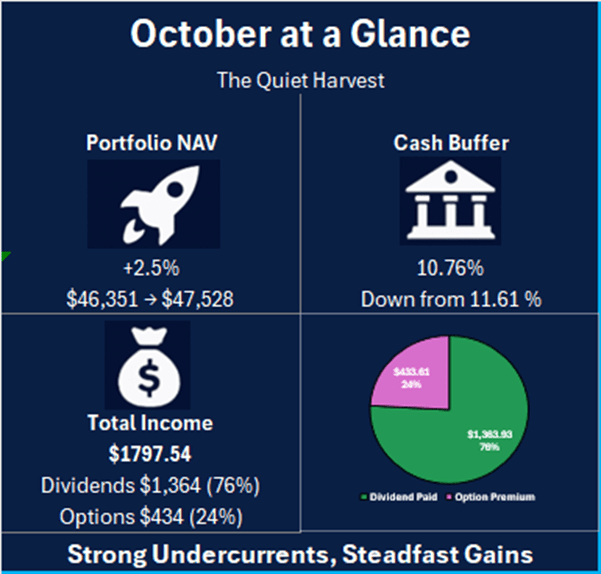
    Growth +2.5%

    Dividends $1,363.93

    Option Income $433.61

    Cash Reserve 10.76%

    October unfolded as a quiet yet defining month for both the market and my portfolio. Beneath the calm surface, undercurrents surged, as the cycle began to take shape anew.

    Technology once again led the charge. OpenAI deepened its strategic partnerships with NVDIA, AMD and Broadcom, securing access to cutting-edge GPUs while co-developing custom AI accelerators that close the gap between model design and silicon performance. The newly launched Stargate initiative, a multi-billion dollar joint venture with SoftBank Group, set in motion the construction of next generation AI data center campuses around the world. At the enterprise level, OpenAI expanded its reach through collaborations with Databricks, integrating its frontier models across more than 20,000 corporate data platforms, and with Guardian Media Group, gained licensed content for both training and real-time use within ChatGPT. Together, these moves have established OpenAI’s presence across the entire AI stack, reigniting strength in the semiconductor and enterprise AI sectors while lifting broader market sentiments.

    For YieldMax investors, such as myself, a quieter but equally important transformation took place. MSTY and CONY completed their transition to weekly dividends, joining ULTY in providing a steadier and more predictable stream of income. The timing of this shift was no coincidence. As crypto markets settled into tighter trading ranges and volatility declined, option premiums linked to MicroStrategy and Coinbase began decaying faster than before. By syncing payouts with their weekly option cycles, YieldMax ensured a more consistent flow of yield even as the broader crypto sector remained muted.

    The macro environment, however, was far from calm. Gold surged past $4,350 mid-month before easing to $4,002.81 by the close, still up 3.6% for October. The move reflected a flight to safety as the U.S. government shutdown dragged on, with negotiations over fiscal spending and federal funding still unresolved. Markets began to price in the growing risk of delayed data releases and reduced policy clarity, pushing investors toward defensive assets and income-based strategies. Overseas, focus turned to Seoul, where President Trump met President Xi Jinping in an attempt to recalibrate trade and security relations. The dialogue was constructive but cautious, producing reassurances without concrete agreements. The meeting underscored a geopolitical backdrop defined by pragmatism rather than partnership.

    In the United States, the Federal Reserve cut interest rates by 25 basis points but warned that no further reductions were likely this year. The move signaled confidence that inflation was cooling within expectations, though the ongoing government shutdown complicated the near-term outlook. Liquidity held steady, yet investor caution grew as federal data gaps limited visibility. With the shutdown still unresolved and diplomacy treading cautiously abroad, October proved to be a test of patience and conviction across markets.

    In the cryptocurrency space, Bitcoin retreated 3.9%, falling from highs near $125,000 to around $109,000, while Ethereum held steady near $3,400. Trading volumes thinned through the latter half of the month, signaling a shift toward accumulation rather than capitulation. For crypto-linked assets such as MSTY and CONY, this quieter environment provided the ideal backdrop for their transition to a weekly dividend model, mirroring the structure that had already proven successful with ULTY.

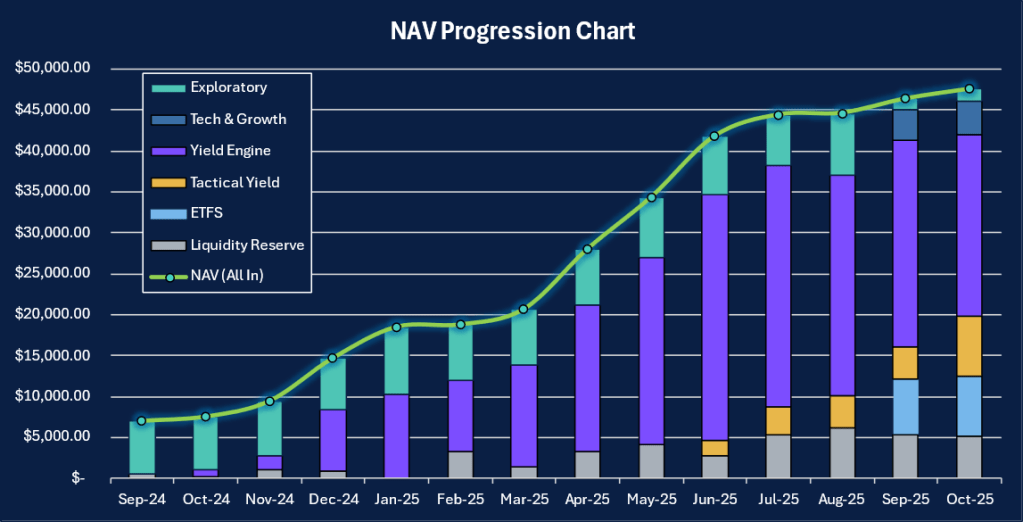
    Through all these currents, the portfolio remained composed. NAV rose 2.5% to $47,528, supported by weekly dividends, disciplined option income, and a strong cash reserve. October may have been marred by uncertainty, but at the portfolio level, it stood calm and quietly resilient.

    Let’s unpack it.

    • NAV Rose Steadily
      The portfolio’s value increased by 2.5% in October, closing at $47,528. Total Equity grew by $1,177, a modest but steady gain even though the market faced tricky and cautious conditions. Growth was supported by consistent yield and offsetting the effects of policy uncertainty and the ongoing government shutdown.
    • Income Flow Remained Firm
      Total income reached $1,797 (+24.9%), comprising $1,364 (+10.4%) in dividends and $434 (+112.6%) from option premiums. The transition of MSTY and CONY to weekly dividends is now complete. With this change, the entirety of the Yield Engine now pays weekly, providing a stable flow of cash.
    • Liquidity Reserve Slightly Reduced
      The Liquidity Reserve closed at $5,113 (10.8% of NAV), down slightly from September (-1.8%). The small reduction reflected controlled reinvestment into income-producing positions while maintaining enough flexibility for tactical opportunities in November.
    • Yield Engine Consolidated
      The Yield Engine closed $22,044 (-12.6%), as MSTY and CONY adjusted to their new weekly payout model. These paper declines were largely offset by $1,364 in realized dividend income, illustrating the trade-off between capital stability and ongoing yield. The segment continues to deliver predictable cashflow, maintaining its purpose as the portfolio’s core income driver.
    • ETFs Led the Recovery
      ETF holdings (CSPX, IWDA, VWRA) rose from $6,725 to $7,342 (+9.2%). Broader market resilience and defensive rotation supported global equity ETFs, which continued to serve as the portfolio’s stabilizing anchor amid yield-segment volatility. The category remained a reliable contributor to NAV growth, reinforcing the long-term base of the portfolio.
    • Tactical Yield Expanded
      SOFI rose from $3,963 to $7,420 (+87.2%), driven by accumulated options income and tactical position scaling. The increase reflected a blend of capital appreciation and consistent premium harvesting from short-term put and call strategies. The position continued to serve as a flexible yield engine within the portfolio, complementing the steady weekly income produced by the YieldMax suite.
    • Tech & Growth Strengthened
      Tech and growth stocks rose 9.0%, led by NET (+18%), NVDA (+8.5%), and PLTR (+9.9%). The sector benefited from renewed optimism following OpenAI’s expanded partnerships with major chipmakers and data firms, strengthening the long-term AI narrative.
    • Exploratory Growth Advanced
      Exploratory holdings increased $1,455 (+15.3%), supported by gains in 640 (+12.4%) and 9MT (+18.2%). Although still small at 3.1% of NAV, this segment adds regional and sector diversity, with selective exposure to emerging opportunities. The move in 640 also reflected its recent share consolidation, a structural change rather than a price catalyst.
    • Portfolio Structure Reinforced
      The framework continues to work well, offering clarity, balance, and direction for capital deployment. Each segment contributed to stability in a month defined by shifting global conditions, disciplined reinvestment, and consistent income generation.

    October closed with the portfolio at $47,528, up 2.5% from September’s $46,351. The increase was modest but steady, marking the fourth straight month of growth even as markets moved cautiously through rate cuts, fiscal uncertainty, and the ongoing government shutdown.

    Performance this month was led by Tactical Yield, where SOFI nearly doubled to $7,420. Accumulated option income and controlled scaling helped it capture volatility that other segments avoided, turning short-term market hesitation into yield.

    The Yield Engine softened to $22,044 (–12.6%) after MSTY and CONY adjusted to their new weekly payout rhythm. Yet, the segment’s consistent distributions continued to anchor overall income, cushioning the drawdown with $1,364 in realized dividends.

    ETFs provided quiet strength, rising 9.2% to $7,342. They offered balance through defensive exposure to CSPX, IWDA, and VWRA, which absorbed volatility from income assets.

    Meanwhile, Tech & Growth added momentum, up 9.0% to $4,152, as optimism around OpenAI’s expanding AI partnerships reignited sentiment across semiconductor and enterprise technology names.

    The Exploratory Growth segment grew 15.3% to $1,455, helped by 640 and 9MT, with the latter’s regional exposure adding quiet strength. 640’s recent share consolidation adjusted its trading profile without changing underlying value, keeping this category’s contribution measured yet meaningful.

    Finally, the Liquidity Reserve settled at $5,113 (10.8% of NAV), maintaining flexibility for new opportunities in November while sustaining a comfortable buffer.

    Together, these movements painted a month of controlled progression. Tactical execution at the edges, quiet consistency at the core, and a portfolio structure that continues to function exactly as designed.

    ETFs Expanded
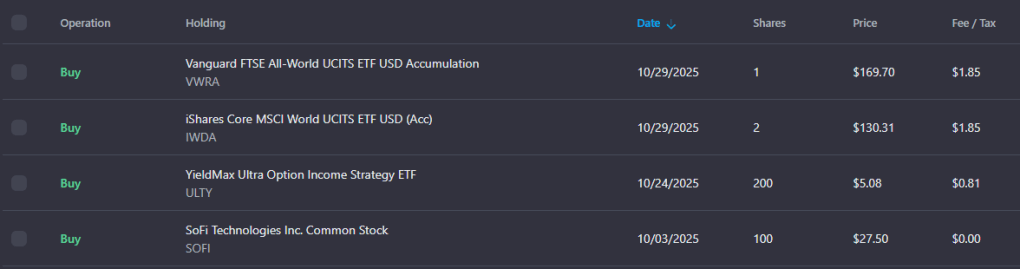
    2 IWDA shares and 1 VWRA share were added in October, modestly increasing total ETF exposure. The ETF layer now stands at $7,342 (+9.2%). This expansion strengthened the base of long-term compounding while providing balance against higher-yield segments. Global indices remained stable despite macro uncertainty, and these selective additions ensured continued participation in the broader equity recovery.

    Yield Engine Reinforced
    An addition of 200 ULTY shares brought total holdings to 1,500, reinforcing the weekly dividend foundation. MSTY and CONY maintained their share counts but officially completed the transition to weekly payouts, aligning with ULTY’s schedule. Although MSTY fell 22.0% and CONY declined 7.8%, the segment still generated $1,364 in dividend income. This steady flow preserved momentum and reaffirmed the Yield Engine’s role as the portfolio’s income anchor.

    Tactical Yield Grew
    The SOFI position increased from 150 to 250 shares, supported by deliberate scaling and active option management. Its value rose 87.2%, reflecting both capital appreciation and consistent premium collection. Option income totaled $434, confirming SOFI as the portfolio’s most flexible and responsive source of yield heading into the final quarter of the year.

    Tech & Growth Retained
    No new positions were added within Tech & Growth, but existing holdings performed well. NET gained 18%, NVDA rose 8.5%, and PLTR advanced 9.9% as enthusiasm returned to the AI and semiconductor sectors following OpenAI’s expanded industry partnerships. The segment continues to provide targeted exposure to innovation while remaining proportionally small to preserve overall portfolio balance.

    Exploratory Footprint Initiated
    No share changes occurred within the Exploratory sleeve, yet total value rose 15.3% to $1,455. Gains in 640 and 9MT, along with 640’s share consolidation, improved trading stability and visibility. Though small at 3.1% of NAV, this sleeve adds regional and small-cap diversification that supports long-term growth potential.

    Liquidity Managed
    Cash reserves closed at $5,113, representing 10.8% of NAV, slightly lower than September’s 11.6%. The reduction came from reinvestments into ETFs, ULTY, and SOFI, reflecting measured capital deployment rather than reduced liquidity discipline. The reserve remains healthy and ready for tactical opportunities in November.

    Volatility & Rates

    What was expected

    Investors entered October expecting a calm environment. The market consensus was that the Federal Reserve’s 25-basis-point rate cut would provide short-term support to equities and ease funding costs without reigniting inflation. Many believed the government shutdown would be resolved quickly, minimizing impact on liquidity or data flow. Volatility was expected to stay contained, with attention shifting back to corporate earnings and macro normalization.

    What happened

    The Fed followed through with the rate cut, but its tone turned unexpectedly firm. Policymakers signaled that no further reductions were likely this year, dampening expectations for a prolonged easing cycle. Meanwhile, the shutdown dragged on, leaving investors without official data on employment, CPI, and growth. The absence of reliable indicators increased market hesitation.

    Gold climbed to $4,350 mid-month before settling at $4,002.81, closing 3.6% higher. The rally reflected demand for safety as confidence in fiscal management weakened. Treasury yields held stable, and equity volatility remained moderate, but risk appetite narrowed sharply toward defensive positioning.

    How the portfolio responded
    The portfolio leaned on its internal rhythm of consistency. Weekly distributions from the Yield Engine maintained cashflow even as prices softened. The ETF layer provided additional stability, rising 9.2% as global markets steadied. Liquidity remained intact at 10.8%, preserving tactical flexibility. Rather than chase market relief, the portfolio held course, focusing on cash generation and steady reinvestment.

    Crypto & Equity Performance

    What was expected

    Coming into the month, the crypto market was projected to consolidate after September’s rally. Analysts anticipated tighter trading ranges, with Bitcoin hovering near $120,000 and Ethereum around $3,400. The expectation was for lower volatility and sustained premiums for option-based yield strategies. On the equity side, investors looked for continued momentum in technology, supported by optimism around AI adoption and stable earnings.

    What happened

    Bitcoin declined 3.9%, sliding from near $125,000 to around $109,000, while Ethereum held steady near $3,400. Trading volumes thinned as speculative interest waned. Option premiums decayed faster than expected, prompting MSTY and CONY to transition to weekly dividends to align payouts with realized income.

    Equity markets remained resilient. OpenAI’s expanded partnerships with NVIDIA, AMD, and Broadcom boosted semiconductor optimism, while the Stargate initiative with SoftBank Group reinforced confidence in large-scale AI infrastructure. Collaborations with Databricks and Guardian Media Group extended OpenAI’s enterprise reach, driving renewed interest across AI-linked equities. NET (+18%), NVDA (+8.5%), and PLTR (+9.9%) all advanced, while broader indices traded sideways amid caution.

    How the portfolio responded

    The portfolio’s income design absorbed the crypto slowdown smoothly. The Yield Engine continued generating steady payouts, offsetting short-term valuation dips in MSTY and CONY. The Tactical Yield sleeve, led by SOFI, captured market inefficiencies through short-dated put and call strategies, producing an 87.2% gain for the month. ETFs added quiet balance, rising 9.2% and reinforcing the defensive core. Overall, the portfolio finished 2.5% higher, driven by disciplined management rather than market momentum.

    Outlook for November

    November begins with a mix of caution and opportunity. The government shutdown continues, leaving markets data-blind but not directionless. Rate policy has stabilized, and inflation pressures appear contained, suggesting a potential window for tactical yield strategies.

    For the portfolio, the focus remains unchanged. The Yield Engine’s synchronized weekly cycle will sustain predictable income. SOFI’s Tactical Yield positioning will continue to exploit short-term volatility selectively, while ETFs anchor long-term stability.

    Patience will again be the priority. With rates steady, income reliable, and liquidity preserved, November is expected to reward disciplined accumulation rather than aggressive rotation.

    Here’s how we performed against our August targets at a glance:

    Base Goals

    ✅ Income Goal: Generate at least $1,300 — Exceeded

    Total income reached $1,797, comprising $1,364 in dividends and $434 in options premiums. The transition of MSTY and CONY to weekly payouts strengthened the portfolio’s income rhythm, providing smoother and more consistent cashflow than in prior months.


    ️ Cash Reserve: Maintain between 10% and 12% of NAV— Met

    Reserves closed at $5,113, or 10.8% of NAV, slightly below September but still within the target range. The small drawdown reflected controlled redeployment into ULTY and ETFs while maintaining adequate flexibility for tactical entries in November.


    ✅ Option Selling: Focus only if premium exceeds 2.5% — Met

    SOFI remained the sole active option engine for October, involving four key trades across both puts and calls.

    • Average realized yield: 3.2% per trade (above the 2.5% benchmark)
    • Highest yield: 4.5% on the 26.5 Put (Oct 31 expiry)
    • Assignment: 1 Put at $27, establishing 100 shares at an effective cost of $26.52
    • Net premium earned (after all Buy-to-Close and fees): $434

    ✅ Yield Engine Stability: Hold through volatility — Met

    Despite short-term drawdowns in MSTY and CONY, distributions remained uninterrupted. ULTY rose 4.6% following capital additions, reinforcing total portfolio yield stability even as prices fluctuated.


    Stretch Goals

    ✅ Total Income: Exceed $1,500 — Achieved

    Monthly income totaled $1,797, well above the stretch target, supported by synchronized weekly payouts and active SOFI premiums.


    ✅ NAV Growth: Add $2,000 to $3,000 — Partially Met

    Portfolio NAV grew 2.5%, from $46,351 to $47,528, a gain of $1,177. The slowdown was largely due to MSTY price compression, though steady income offset most of the capital drag.


    ✅ Strategic Deployment: Add to CSPX, IWDA, or ULTY selectively — Met

    Additional 200 ULTY shares were acquired, alongside ETF reinforcements in CSPX and IWDA. These additions strengthened both yield and stability layers ahead of the November cycle.


    ✅ Risk Discipline: Maintain controlled exposure — Met

    Only one SOFI option was open at any given time, and all short legs were closed or rolled before expiry. This preserved capital safety and kept exposure aligned with volatility shifts.


    ✅ Exploratory Layer: Maintain below 3% of NAV — Met

    640 and 9MT advanced modestly (+12% and +18% respectively) while staying within allocation limits. This layer continued to provide small but meaningful diversification benefits.

    October Transactions

    • ULTY
      Purchased 200 shares at $5.08 on October 24, expanding the core Yield Engine allocation to 1,500 shares in total. This addition reinforces the portfolio’s weekly income base and improves yield consistency going into November.
    • IWDA
      Added 2 shares at $130.31 on October 29, strengthening global developed market exposure. The move complements CSPX and aligns with the objective of gradual reinforcement of the ETF layer for long-term stability.
    • VWRA
      Purchased 1 share at $169.70 on October 29. This incremental addition broadens passive exposure across both developed and emerging markets, rounding out the Global Core ETF segment.
    • SOFI
      Acquired 100 shares at $27.50 on October 3 after put assignment. The new shares formed part of the tactical yield sleeve and enabled covered call positions later in the month, maintaining continuous premium generation within controlled risk limits.
    • Liquidity Reserve
      The cash balance adjusted downward following reinvestments into ULTY and ETFs. The portfolio closed with a reserve of $5,113, equal to 10.8% of NAV, preserving sufficient flexibility for tactical opportunities in November.

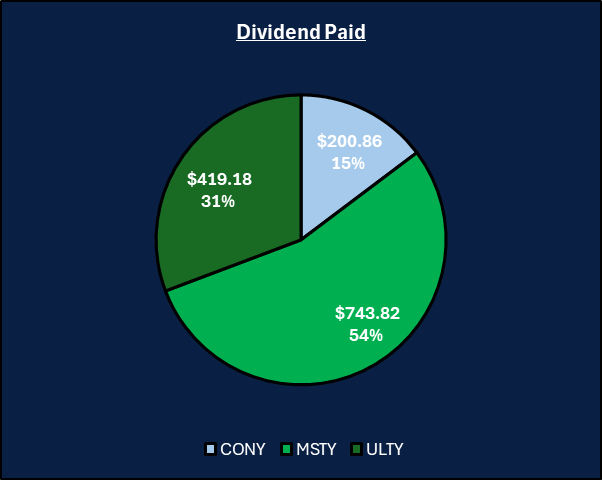
    October delivered $1,797.54 in total income, a 24.9% increase from September. Dividends made up $1,363.93 (76%), while options contributed $433.61 (24%). The income mix continued to lean toward stable, recurring distributions while retaining tactical upside from options.

    Dividend Highlights ($1,364)

    • MSTY: $743.82, a slight increase compared to September.
    • ULTY: $419.18, distributions increased due to additional ULTY additions
    • CONY: $200.86, a slight increase compared to September.

    Option Activity ($434)

    • All option trades in October came from SoFI
    • 4 short puts were opened and closed profitably, with one position assigned at the $27 strike, creating 100 new shares at an effective cost basis of $26.52 after premiums.
    • 1 short call was sold at the $32 strike and later bought back for a small gain, maintaining position flexibility as SOFI consolidated near $28–29.
    • Average yield on strike: 3.2%, with the highest single trade return at 4.5% on the $26.5 put (Oct 31 expiry).
    • Average holding period: 7–10 days, keeping exposure short and responsive to price movement.

    Yield Profile

    • Overall Yield: 3.2 %
      • Dividends: 3.2 %
      • Options: 1.0 %

    Another month of stable performance across all yield engines. The portfolio’s blended yield of 3.2% demonstrates the balancing of passive income strength with active yield enhancement.

    November will focus on maintaining rhythm rather than expansion. With all YieldMax funds now paying weekly, the income engine is fully synchronized. The plan is to preserve this, manage SOFI options selectively for tactical yield, and gradually strengthen ETF positions on meaningful pullbacks. Cash reserves will remain above 10% to safeguard flexibility while monitoring opportunities as volatility and policy signals unfold.

    Area of Focus

    • Maintain income Discipline
      With all YieldMax funds now aligned to weekly payouts, the focus shifts toward maintaining consistency rather than expansion. The goal for November is to sustain income above $1,700, keeping weekly flows uninterrupted while monitoring MSTY and CONY for any payout drift following their transition.
    • Tactical Option Rotation
      Continue managing SOFI through short-duration puts and selective covered calls, targeting 2.5% or higher returns on strike. Maintain only one active position at a time to preserve risk control and liquidity. If volatility expands post-shutdown resolution, consider widening strikes slightly for improved premium capture.
    • Reinforce ETF Stability
      Gradually increase CSPX and IWDA on meaningful dips to strengthen the defensive layer. ETF adds remain the foundation of long-term compounding and will serve as the stabilizer should volatility return in late Q4.
    • Preserve Liquidity Buffer
      Keep the cash buffer above 10% of NAV. With volatility lingering and rate direction uncertain, the reserve will remain essential for opportunistic entries and capital protection. Avoid large deployments until macro clarity improves.
    • Monitor Yield Sustainability
      Track the effective yields of MSTY and ULTY relative to NAV. If price pressure continues without distribution erosion, consider selective reinvestment to compound weekly returns at more attractive valuations.

    Base Target

    • Income Goal:
      Generate at least $1,700 in total income, primarily through weekly dividends from MSTY, CONY, and ULTY, supplemented by tactical SOFI options. Maintain continuity in distributions and protect the month’s payout rhythm.
    • Liquidity Reserve:
      Keep reserves between 10% and 12% of NAV to preserve flexibility for tactical entries. Avoid new large-scale deployments until market clarity improves following the ongoing shutdown and Fed policy recalibration.
    • Equity Exposure:
      Add selectively to CSPX or IWDA on meaningful pullbacks. Focus on strengthening the ETF base to balance yield-driven segments and reduce sensitivity to market volatility.
    • Option Selling:
      Continue using SOFI short puts and covered calls only if returns exceed 2.5% of strike value with expiries under 14 days. Maintain single-position exposure at all times to control leverage and margin usage.
    • Yield Engine Stability:
      Hold MSTY, ULTY, and CONY through short-term volatility. Reinvest only if prices decline more than 5% without a reduction in distribution. The priority remains yield sustainability, not price recovery.

    🚀 Stretch Goal

    • Total Income:
      Exceed $1,900 through combined weekly dividends and optimized option premiums.
    • NAV Growth:
      Increase NAV by $1,500 to $2,000, driven by earned income and incremental ETF reinforcement.
    • Strategic Deployment:
      Allocate up to $1,000 into ETFs if market weakness deepens mid-month, reinforcing the stability pillar before year-end distributions.
    • Risk Management:
      Maintain portfolio delta near current neutral levels. Avoid overexposure to crypto-linked volatility until BTC sustains above $115,000 for two consecutive weeks.
    • Exploratory Layer
      Monitor 640 (HKEX) and 9MT (SGX) for volume-based breakouts. Add only upon confirmation of strength and keep allocation under 3% of NAV.

    The goal is to let structure do the work. To stay patient, keep yield steady, and let the compounding take care of the rest.

    October was a month of quiet strength. The market shifted beneath the surface, yet the portfolio held its rhythm. Weekly income flowed as designed, the Yield Engine ran smoothly, and tactical discipline around SOFI kept risk contained while adding meaningful yield.

    The shift of MSTY and CONY to weekly dividends marked a structural milestone, turning the portfolio into a true weekly income system. Each segment functioned in balance, showing that consistency can sometimes outperform excitement.

    As November begins, the focus remains on maintaining tempo rather than expansion. The target is to preserve steady cashflow, keep reserves above 10%, and reinforce the ETF base on meaningful dips. The aim is not to chase volatility but to let structure and rhythm do the work.

    Strong undercurrents remain, but the gains remains steadfast.


    October reminded me that discipline is often the quietest strength in investing. The past month was not driven by headlines or surprises but by steady income, measured positioning, and patience rewarded in small, consistent increments.

    What are you focusing on this quarter? Are you building yield, reinforcing your base, or waiting for volatility to return before redeploying?

    Share your thoughts below.

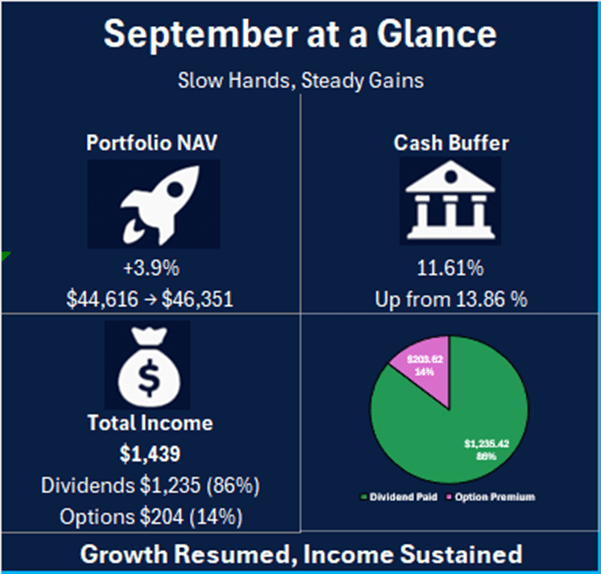
  • Month 12 Snapshot: Slow Hands, Steady Gains
    📈

    Growth +3.9%

    Dividends $1,235.42

    Option Income $203.62

    Cash Reserve 11.61%

    We are now entering the last quarter of the year.

    A full year has passed since we started this journey. What began as a small experiment to track a new family of YieldMax funds has grown into something larger. The numbers have become a story of their own, one of discipline, resilience, and quiet intent.

    Just as markets and technology evolves, so must we. Our portfolio must grow with them, shaped by the same clarity and purpose that guide the world we invest in. Each shift sharpens our blade and tests our strategy with greater intensity, reminding us that progress not only depends on speed, but also on precision.

    September reflected that evolution. The new categories were introduced to bring sharper clarity to the composition of the portfolio, allowing for clearer segregation and the development of a more intricate sub-strategy within the system.

    Bitcoin opened the month at $109,250, pushing higher through the first half of September to test $117,900. Momentum faded toward the end of the month as profit-taking set in, and by September 30, it closed at $114,056, marking a monthly gain of about 4.4%. The move was steady and controlled, a welcome sign of maturing sentiment.

    The Nasdaq Composite showed similar strength. It started the month at $21,279, climbed steadily to a high of $22,801 mid-month, and ended September at $22,660, up 6.5%. Technology led the charge once again, supported by renewed optimism in artificial intelligence and a softer yield outlook from the Federal Reserve.

    My portfolio moved in tandem with these trends. The Yield Engine (MSTY, ULTY) continued to generate steady dividends, delivering payouts even as share prices softened slightly. The ETFs (CSPX, IWDA and VWRA) did the heavy lifting, contributing to the bulk of this month’s gains. SOFI remained the tactical yield driver, benefiting from short-term volatility that helped capture consistent option premiums. Total income came in at $1,439, with $1,235 from dividends and $204 from option premiums.

    All in all, it was not a month of dramatic swings, but one of stable and quiet growth, a reminder that progress is built on consistency, not intensity.

    Let’s unpack it.

    • NAV Growth Continued
      The portfolio rose 3.9% in September, closing at $46,351. Total equity value increased by $2,447, driven primarily by strong gains in ETFs (+60.0%) and a solid rebound across Tech & Growth (+11.7%) holdings.
    • Income Flow Remained Firm
      Total income reached $1,439, with $1,235 from dividends and $204 from option premiums. Weekly flows from MSTY, ULTY, and CONY kept the income stream intact even as prices softened.
    • Liquidity Reserve Slightly Reduced
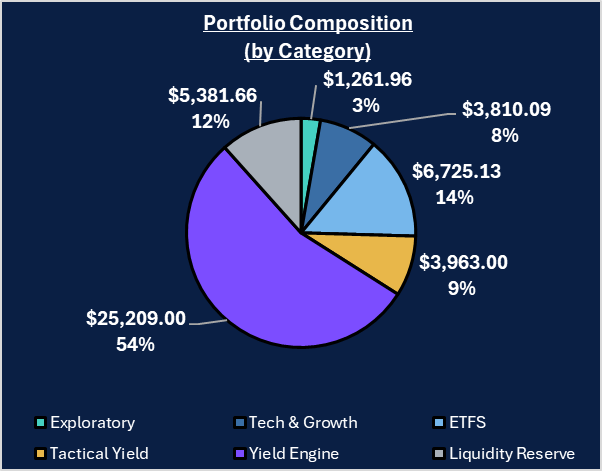
      The Liquidity Reserve decreased by 12.9% to $5,381, reflecting redeployment of capital into ETF and exploratory positions. Despite the reduction, the cash buffer held at 11.6% of NAV, preserving flexibility for tactical trades in October.
    • Yield Engine Consolidated
      The Yield Engine closed at $25,209, down 6.9% month-on-month. MSTY saw a 9.9% drawdown, while ULTY slipped 3.5% Steady distributions helped offset these decline and sustained portfolio income.,
    • ETFs Led the Recovery
      The ETF segment (CSPX, IWDA, VWRA) grew from $4,202 to $6,725, a gain of $2,523 (+60%). This category was the top contributor to NAV growth, supported by increased investments and a strong September rally in the S&P 500 and global markets.
    • SoFI Continued as a Tactical Engine
      SOFI, the sole Tactical Yield position, rose 3.4% to $3,963. Option premiums remained the main yield driver, complementing dividend income from the Yield Engine.
    • Tech & Growth Strengthened
      This segment climbed 11.7% , led by NET (+27% ), NVDA (+7% ), and BB (+27% ). Selective exposure to tech names proved effective as the Nasdaq advanced 6.5% for the month.
    • Exploratory Growth Awakened
      The Exploratory Growth segment surged from $1.29 to $1,261.96, up 977% , reflecting new allocations into 640 (HKEX) and 9MT (SGX). While still a small portion of NAV (2.7% ), it adds regional diversity and optional upside.
    • Portfolio Structure Reinforced
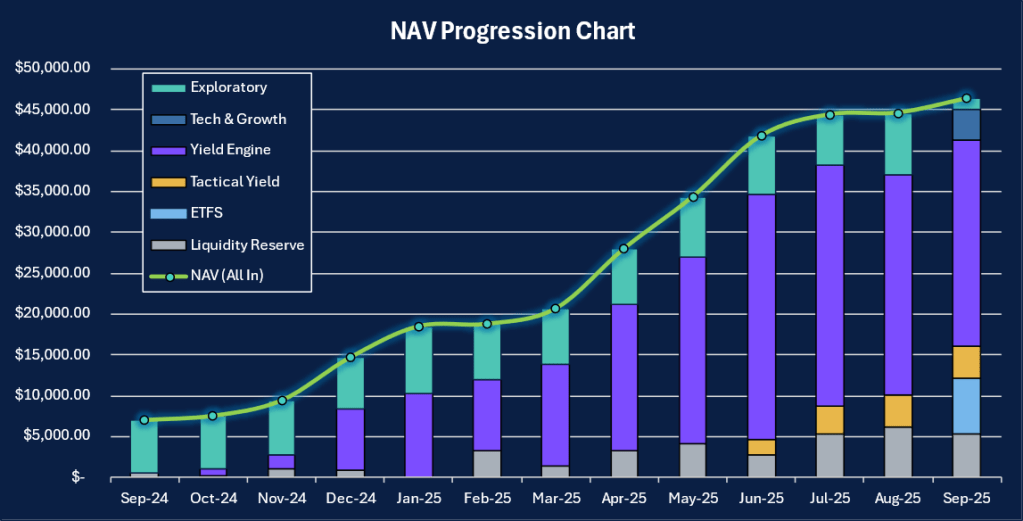
      September completed the transition into a six-category framework: Yield Engine, ETFs , Tactical Yield, Tech & Growth, Exploratory Growth, and Liquidity Reserve.

    September closed with the portfolio at $46,351, up 3.9% from August’s $44,616. The increase was moderate but broad-based, marking the third consecutive month of positive growth.

    The ETFs led performance once again, climbing 60% to $6,725. 2 new CSPX shares and 5 additional IWDA shares were added during the month, strengthening long-term stability and global diversification. Together with VWRA, the ETF segment now represents 14.5% of NAV and serves as the portfolio’s defensive backbone.

    The Yield Engine, still the largest allocation at 54.4% , eased slightly to $25,209 as MSTY and ULTY prices softened. Even so, the segment continued to generate weekly income and remains the portfolio’s primary cash-flow source.

    The Tactical Yield sleeve, represented by SOFI, advanced 3.4% to $3,963. Short-term option selling kept returns steady while controlling downside exposure.

    Tech & Growth positions gained 11.7% , ending at $3,810. Strength in NET (+27% ), BB (+27%), and NVDA (+7%) lifted the segment as the Nasdaq rose 6.5% for the month.

    The Exploratory Growth category, including 640 (HKEX), 9MT (SGX), and 5UA (SGX) — expanded to $1,262 or 2.7% of NAV, reflecting a deliberate step into regional and small-cap opportunities.

    Lastly, the Liquidity Reserve stood at $5,382, or 11.6% of NAV. The minor drawdown reflects the ETF purchases while keeping a healthy buffer for tactical moves in the final quarter.

    Overall, September showed quiet strength. Yield engines held their ground, global ETFs took the lead, and new categories brought structure and clarity to both risk and return.

    ETFs Expanded
    Selective additions were made to the ETF layer with two CSPX and five IWDA shares added in September. The goal was simple. To strengthen the base of long-term stability and compound growth while maintaining balance against higher-yield exposures.

    Yield Engine Held Course
    No new positions were opened within the Yield Engine. MSTY and CONY continued their monthly payouts, while ULTY delivered steady weekly flows. Price softness in MSTY and ULTY was offset by consistent distributions, keeping income momentum intact.

    Tactical Yield Stayed Light
    SOFI remained the only active tactical yield play. Options were managed selectively, capturing premiums without increasing margin exposure. No additional contracts were opened at month-end, keeping risk measured and liquidity ready for Q4 opportunities.

    Tech & Growth Retained
    Core tech names NVDA, NET, and PLTR were maintained with no new entries. These remain satellite growth drivers, kept intentionally small to preserve portfolio balance while participating in the sector’s recovery.

    Exploratory Footprint Initiated
    September marked the first deployment into the Exploratory Growth sleeve, introducing 640 (HKEX) and 9MT (SGX). Allocations are small by design, allowing gradual observation of market response before scaling exposure.

    Liquidity Managed
    Cash levels were trimmed slightly following ETF purchases, yet the 11.6% buffer remains intact. The reserve continues to serve as both protection and optional firepower for tactical entries should volatility resurface.

    Volatility & Rates

    What was expected

    September began with markets expecting volatility to ease further after a calm August. Softer inflation data and stable macro readings supported the idea that the VIX would drift lower toward the 14–15 range, while Treasury yields were expected to hold steady. Analysts anticipated another quiet month driven by cautious optimism and lower market stress.

    What happened

    Instead, volatility edged higher. The CBOE Volatility Index (VIX) gained about one point, closing at 16.28 on 30-Sep-2025, within an intraday range of 16.02 to 16.70. This marked its second consecutive monthly increase, even as both the S&P 500 and Russell 2000 posted solid gains. Treasury yields were little changed, with the U.S. 10-year ending the month near 4.25% . The slight rise in VIX reflected modest hedging rather than panic, suggesting investors were securing profits while remaining engaged in risk assets.

    How the portfolio responded
    The portfolio maintained a steady stance amid the uptick in volatility. The mild increase in option premiums benefited SOFI’s tactical spread strategy, while core holdings such as MSTY and ULTY continued to deliver consistent weekly distributions. The ETFs held firm as yields stabilized, reinforcing balance between income and growth positions. Overall, the portfolio benefited from a market that was calm but cautious, favoring income continuity over speculative expansion.

    Crypto & Equity Performance

    What was expected

    Coming out of August’s mild drawdown, most analysts expected a subdued month for crypto. Liquidity remained thin, ETF inflows had slowed, and sentiment pointed toward consolidation rather than breakout. Bitcoin was forecast to trade quietly around the $110,000 level, with limited volatility.

    What happened

    Crypto markets instead delivered a measured rebound. Bitcoin opened September at $109,250 and climbed to $117,900 mid-month before easing to close at $114,056, up 4.4% . Volatility narrowed, and trading volumes stabilized. Ethereum underperformed slightly as ETF inflows cooled but continued to attract institutional demand. The tone was constructive, marked by steadier price action and reduced speculative churn.

    How the portfolio responded

    The Yield Engine maintained consistent performance. CONY, which tracks Coinbase through an option-income strategy, provided steady distributions despite reduced crypto volatility. Exposure to MSTY and ULTY remained unaffected, ensuring stable income flow even as crypto markets consolidated. The portfolio maintained minimal direct crypto exposure, choosing instead to capture yield through structured products rather than price speculation.

    Outlook for October

    October will be a test of discipline. Markets have regained their footing, yet confidence remains fragile. The slight rise in volatility at the end of September hints that investors are still hedging against surprises, while economic data continues to balance between strength and fatigue.

    Attention will turn to Washington, where uncertainty surrounding a potential U.S. government shutdown could momentarily unsettle markets. Historically, such events tend to lift short-term volatility and weigh on investor sentiment, though the impact often fades once a funding resolution is reached. For now, the risk is more psychological than structural, but it adds another layer of caution to an already delicate environment.

    Equities may see slower momentum as valuations stretch and earnings guidance takes the spotlight. Technology remains resilient, but leadership could rotate toward sectors that benefit from stable yields, such as financials and infrastructure. The portfolio’s ETF base will continue to anchor this transition, providing balance if short-term pullbacks emerge.

    For the Yield Engine, October will focus on consistency rather than expansion. MSTY, CONY and ULTY will continue to provide dependable periodic payouts. The goal is to preserve cash flow and use any brief volatility spikes as opportunities to accumulate income assets.

    The Tactical Yield sleeve, anchored by SOFI, will stay selective. Option spreads will be deployed only when risk-reward aligns, keeping exposure light and premiums steady.

    In essence, October is not about chasing momentum but maintaining rhythm. The portfolio enters the month well-positioned: cash at 11.6% , yield engines intact, and global exposure balanced. The focus now shifts from recovery to refinement. Staying patient, staying funded, and letting quiet compounding do its work.

    Here’s how we performed against our August targets at a glance:

    Base Goals

    ✅ Income Goal: Generate at least $1,200 — Exceeded

    Total income reached $1,439, comprising $1,235 in dividends and $204 in options premiums.


    ️ Cash Reserve: Maintain between 10% and 14% of NAV— Met

    Reserves ended at 11.6 % of NAV, within range and near the midpoint of the target band. The portfolio maintained ample flexibility for tactical opportunities without overextending exposure.


    ✅ Option Selling: Focus only if premium exceeds 2.5% — Met

    SOFI remained the sole option engine. All puts cleared the 2.5% return hurdle and were managed with short expiries. No positions were left to assignment.


    Stretch Goals

    ✅ Total Income: Exceed $1,500 — Slightly Missed

    September’s $1,439 came close but fell short of the stretch mark. The absence of a double MSTY payout (which boosted August) kept overall income slightly below target, though yield stability remained intact.


    ✅ NAV Growth: Add $2,000 to $3,000 — Met

    NAV grew 3.9 %, from $44,616 to $46,351, driven by ETF strength and broad equity gains. The rebound in Tech & Growth positions, combined with steady yield flow, provided the lift needed to outpace expectations.


    ✅ Selective Reinvestment: Add ULTY or MSTY — Deferred

    Neither fund presented an attractive discount during the month. Focus shifted toward strengthening ETF exposure instead, prioritizing global diversification over concentrated yield expansion.


    ✅ Risk Discipline: Limit to one SOFI CSP — Met

    All SOFI trades were capped at a single active position. Exposure stayed defined, duration short, and profits consistently locked in. Risk discipline remained central to the strategy.

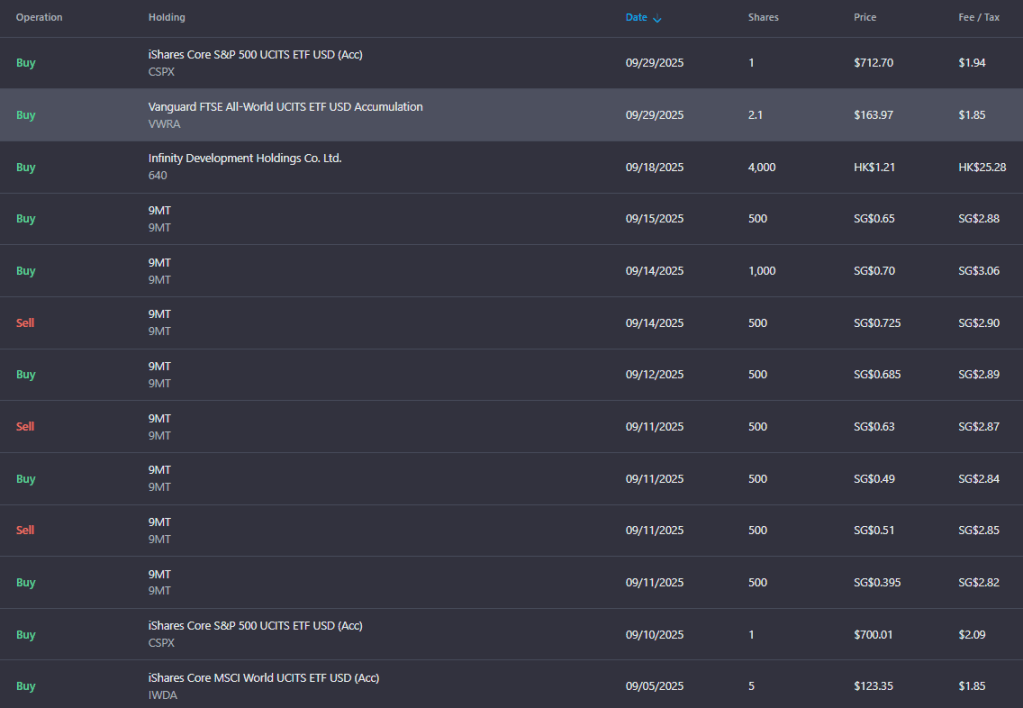
    August Transactions

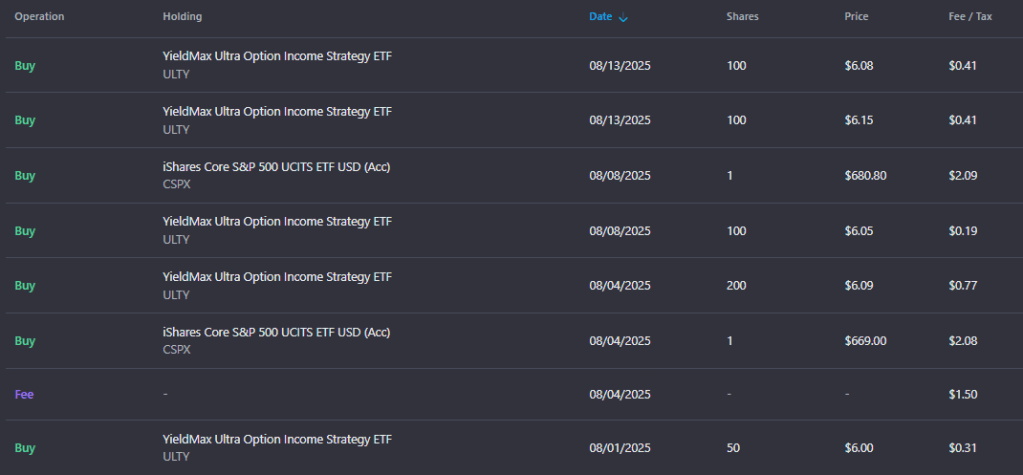
    • CSPX
      Expanded further with two new entries at $700.01 and $712.70, lifting exposure to the S&P 500 core. The additions strengthened long-term stability and reinforced the ETF layer as a defensive anchor.
    • IWDA
      Added five shares at $123.35, broadening diversification into global developed markets. This complements CSPX and supports the long-term allocation strategy within the Global Core ETFs segment.
    • VWRA
      Initiated a small add of 2.1 shares at $163.97, rounding out global equity exposure and deepening passive diversification across regions.
    • 640 (HKEX)
      Acquired 4,000 shares at HK$1.21 to establish a foothold in Exploratory Growth. This position reflects selective exposure to Hong Kong’s small-cap opportunities while keeping sizing prudent.
    • 9MT (SGX)
      Actively traded through multiple small blocks between SG$0.39 and SG$0.73. Partial sales were executed to manage cost basis and rebalance short-term liquidity. The overall stake remains positioned for recovery momentum.
    • Liquidity Reserve
      Received a $1,562 deposit. Ended the month at 11.6% of NAV, maintaining flexibility for tactical deployment in October.

    September delivered $1,439 in total income, composed of $1,235 from dividends and $204 from options premiums. Though smaller than August’s double-payout surge, the consistency underscored the system’s resilience.

    Dividend Highlights ($1,235)

    • MSTY: $742.72, reduction due to single payment this month.
    • ULTY: $334.43, distributions slightly lower due to market softness
    • CONY: $158.27, a slight increase compared to August.

    Option Activity ($204)

    • All option trades in September came from SoFI
    • A total of 4 short puts were written and subsequently closed for profit.
    • Premiums were taken early, with no assignments or unnecessary exposure.

    Yield Profile

    • Overall Yield: 3.5 %
      • Dividends: 3.0 %
      • Options: 0.5 %

    Income this month was characterized by continuity over surprise. The system functioned exactly as designed.

    The portfolio enters October on solid footing. Income has stabilized, volatility remains contained, and cash reserves sit comfortably above target. The focus now shifts from rebuilding to refining, strengthening structure, tightening execution, and positioning for a measured fourth quarter.

    Area of Focus

    • Reinforce the Core
      Continue gradual additions to CSPX and IWDA when prices consolidate. These ETFs now form the backbone of stability, balancing high-yield volatility with steady capital appreciation.
    • Maintain Yield Discipline
      Keep MSTY and ULTY as primary income engines. Accumulate only if dividend cadence remains uninterrupted and prices dip below intrinsic support. CONY will remain a supplementary yield stream, not a core holding.
    • Tactical Flexibility with SOFI
      Continue deploying options selectively. Only engage when premiums exceed the 2.5% return threshold and risk-reward remains favorable. Volatility spikes linked to U.S. fiscal uncertainty may present brief but attractive entry windows.
    • Preserve Liquidity Buffer
      Maintain the cash reserve near 11–12%. This ensures readiness to seize value opportunities without diluting dividend efficiency. Any excess inflow can be directed toward ETF accumulation later in the quarter.
    • Monitor Macro Signals
      Watch the U.S. government shutdown debate and Treasury yield movement closely. A prolonged stalemate or renewed rate volatility could trigger market dips worth exploiting.

    Base Target

    • Income Goal:
      Generate at least $1,300 in total income, primarily through dividends, with SOFI options as tactical supplement.
    • Liquidity Reserve:
      Maintain cash reserves between 10% and 12% of NAV to preserve flexibility.
    • Equity Exposure:
      Add to CSPX or IWDA only on meaningful pullbacks. The goal is gradual reinforcement of the ETF core, not aggressive accumulation. No new positions outside current categories unless cash reserves exceed 12 percent.
    • Option Selling:
      Focus on SOFI and MSTY puts only if premiums exceed 2.5% return on collateral, with expiries under 14 days.
    • Yield Engine Stability:
      Hold MSTY, ULTY, and CONY through volatility. Monitor payout trends closely. No averaging down unless distributions remain intact and drawdown exceeds 5 percent from current levels.

    🚀 Stretch Goal

    • Total Income:
      Exceed $1,500, supported by double MSTY payout and steady ULTY weekly flows.
    • NAV Growth:
      Lift NAV by $2,000 to $3,000 through earned income and selective reinvestment.
    • Strategic Deployment:
      Allocate up to $2,000 into CSPX, IWDA, or VWRA if market sentiment weakens mid-month. Reinforce the stability pillar ahead of Q4 income cycles.
    • Maintain Risk Discipline:
      Limit to one active SOFI CSP at a time unless reserves exceed 12%. Keep sizing controlled.
    • Exploratory Layer
      Monitor 640 (HKEX) and 9MT (SGX). Add only on clear technical strength or sustained volume breakout. Keep allocation below 3 percent of NAV.

    The goal is to let structure do the work. To stay patient, keep yield steady, and let the compounding take care of the rest.

    The twelfth month marked a turning point. What began as an experiment in income has matured into a living, breathing system that balances yield, growth, and patience in equal measure. The numbers have become quieter now, but more deliberate, shaped not by chance, but by rhythm.

    Markets rose, volatility stirred, and yet the portfolio stood firm. The income engine continued its steady hum while the core expanded in quiet strength. Every trade, every dividend, every option premium was another step in refining the system.

    As the final quarter unfolds, the task ahead is no longer expansion but precision. The structure works. It only needs time to deepen its roots.

    Slow hands. Steady gains. That is how the year will close.


    How are you adjusting your portfolio as the year enters Q4?

    Are you building, holding, selling?

    Share your thoughts below.

  • Stronger Data, Softer Markets

    September 25 brought a quiet pullback. The GDP data was revised upwards, showing the economy grew at an annualized rate of 3.8% from April to June, well above the 3% initially reported. This difference came largely from stronger consumer activity. Personal consumption expenditures rose at an annualized pace of 2.5%, up sharply from the earlier estimate of 1.6%.

    Contrary to the rosy picture painted by these figures, higher spending does not necessarily mean households are buying more. Some economists caution that part of this increase may simply reflect higher prices, rather than genuine strength in demand.

    And the market seems to agree, as shown in yesterday’s performance.

    Asset / IndexCloseChange% Move
    S&P 5006,603.85-34.12-0.51%
    Nasdaq22,376.11-121.75-0.54%
    Dow Jones45,950.27-171.01-0.37%
    Bitcoin (BTC)108,994.49-4,312.51-3.8%

    As can be seen, the pullback was broad. US equities all closed lower, led by Nasdaq’s 0.54% decline. Cryptocurrencies sold off more sharply, with Bitcoin losing 3.8%.

    The contrast between the labor and growth data speaks volumes. Whilst GDP was revised up to 3.8% for Q2, labor market showed slower hiring. The figures reinforce this split. Weekly jobless claims are steady at 218,000, pointing to limited layoffs. Yet only 22,000 jobs were created in August and 911,000 jobs were removed from prior totals after revisions. The unemployment rate had edged up to 4.3%.

    This suggests that the labor market is currently in limbo, not shedding workers, nor adding new ones. Another fact to consider is that the claims data only reflects those eligible for benefits. Stress in gig and contract roles may not show up in the official numbers.

    The next data point that matters most is the Personal Consumption Expenditure (PCE) price index. September’s release, covering August, is due today.

    The PCE data will either confirm or contradict the narrative built by GDP and jobs. If the PCE comes in soft, it would signal that inflationary pressure is easing despite resilient growth. This would prompt the Fed to consider further rate cuts later this year. On the flip side, it would reinforce the case for them to keep rates higher for longer, even as hiring cools.

    Markets are now caught between. With GDP on one hand supporting tight policy, while the job data suggesting otherwise. The PCE is the tie-breaker, and until that print lands, traders are left to balance two conflicting signals. And we know how traders dislike uncertainty.

    Closing Thoughts

    Stronger growth figures met weaker jobs data, and the result was confusion rather than confidence. With the PCE report as the next marker, the path ahead remains uncertain. For investors, the lesson is clear. Stay balanced, keep a margin of safety, and remember that resilience on paper can still feel fragile in practice.

  • Month 11 Snapshot: Quiet Gains in a Noisy Market
    📈

    Growth +0.5%

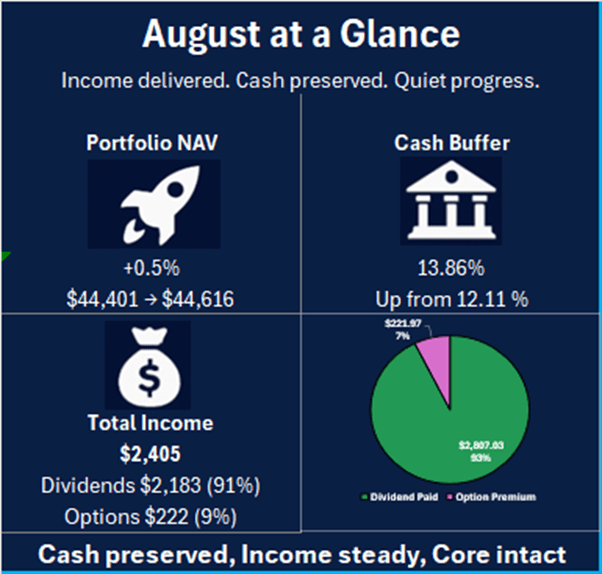
    Dividends $2,183.33

    Option Income $221.97

    Cash Reserve 13.86%

    I am posting this a little later than usual. Life kinda got in the way this month. However, i still believe August 2025 deserved a proper entry.

    The month moved with a split rhythm, one heavy, the other hopeful.

    Bitcoin started off strong from $117,000 to test $124,000 mid month. That momentum did not last, and was soon halted. Heavy selling broke through the support levels and by end of August, it closed at $109,380.

    The Nasdaq told a different story. It opened near $22,800, pushed to a peak of $23,900 around mid-month. Then settled, closing at $23,485 at the end of August.

    My portfolio sat in the middle of this contrast. Yield engines like ULTY and MSTY faltered, with prices trending downwards and dividends reduced. SoFI, on the other hand continued to climb. Even so, August brought in $2,200 in dividends, driven by a double payment from MSTY. It was a reminder that while value swings are out of my hands. the income stream keeps this strategy alive.

    Let’s unpack it.

    • NAV Growth Continued
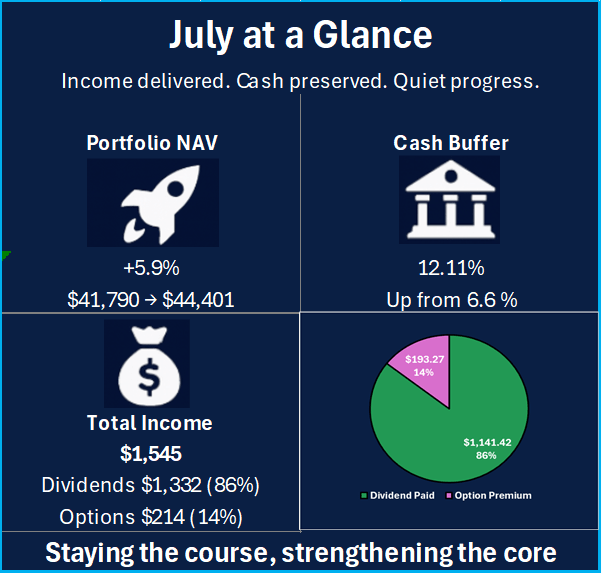
      The portfolio grew by 0.5% in August. NAV rose from $44,401 to $44,616, supported by a fresh capital deposit of $3,107.86. Price weakness offset part of the contribution, leaving only $215 net growth after adjusting for the deposit.
    • Income Reached a New Peak
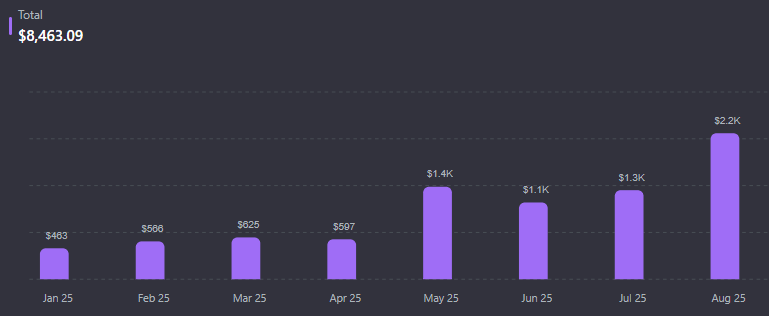
      August’s income totaled $2,405. Dividends contributed $2,183 (91%), lifted by a double MSTY payout, while options added $222 (7%).
    • Cash Position Strengthened
      Cash reserves improved again, climbing from 12.1% in July to 13.9% by end-August, giving more flexibility for tactical deployment.
    • MSTY Remained the Income Driver
      MSTY delivered the largest share of dividends this month, with the double payout boosting results. ULTY and CONY added steady flows, while SOFI contributed through option premiums.
    • ULTY Expansion Accelerated
      550 Shares added in August, reinforcing its role as a core weekly income engine.
    • ETF Exposure Broadened
      CSPX (2 Shares) added to anchor long term stability alongside high yield plays
    • SoFI Continued as a Tactical Engine
      SoFI’s price climb created room for tactical option selling. Active management generated $222 in net premiums, reinforcing its role as a growth and options overlay.
    • Core Focus Stayed on Yield Stability
      No major shifts in holdings this month. Capital remained centered on high-yield engines MSTY, ULTY, and CONY, with broad ETF exposure through CSPX and IWDA acting as stability anchors.

    NAV inched up from $44,401 to $44,616 in August, a modest 0.5% increase. This was supported by a cash deposit of $3,107.86, but weakness across MSTY and ULTY offset most of the contribution. Net portfolio growth after adjusting for the deposit was just $215.

    Yield-focused positions like MSTY, CONY, and ULTY remain the backbone of the portfolio, making up the largest share of NAV. Despite price pressure, their dividend flows kept the income line resilient.

    The cash buffer grew from 12.1% to 13.9%, giving more flexibility to act on opportunities without forced sales.

    SoFI continued to provide tactical income through options, complementing the steady weekly flows from ULTY.

    No fireworks, no fanfare, just the quiet rhythm of income keeping pace.

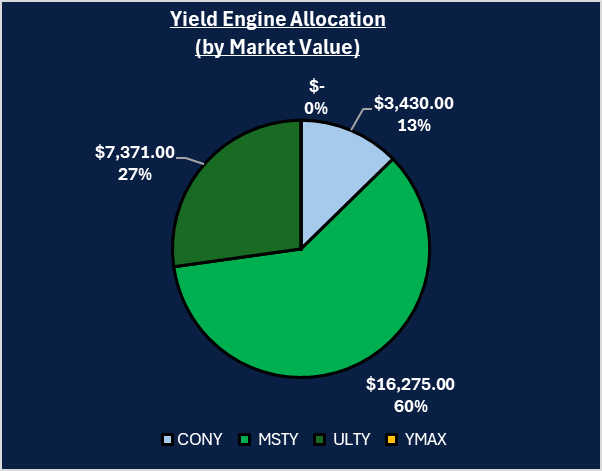
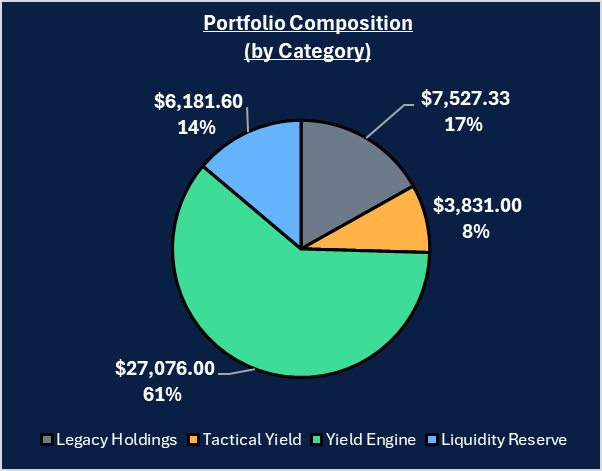
    The portfolio ended August at $44,616, with allocations holding steady. The Yield Engine (MSTY, CONY, and ULTY) still dominated at 60.7% of NAV, supported by 8.6% in Tactical Yield (SoFI), 16.9% in Legacy Holdings, and a 13.9% cash reserve.

    MSTY closed the month at -20.5%, even though its double dividend was the largest single income driver. CONY fell -21.2% weighed down by Coinbase weakness, but dividends continued. ULTY expanded from 750 to 1,300 shares, adding resilience and lifting income. despite price drawdowns.

    SOFI remained a tactical engine, contributing through options premiums. At 8.6% of NAV, it’s a meaningful position but still leaves room to scale if conditions remain favorable.

    Legacy equities accounted for 16.9%, while cash climbed to 13.9% of NAV, aided by a fresh deposit of $3,107.86. Together, they provided balance and the flexibility to adjust without being forced by volatility.

    Overall, core income positions declined 8% in value, but this was partly offset by strength in other equities (+18.5%) due to purchase of CSPX and IWDA, as well as the growing reserve. The structure held, and the focus stayed on steady reinforcement rather than reinvention.

    Volatility & Rates

    What was expected

    August was set up to be quiet. The VIX had been steady, and there was little reason to expect a shake-up. The Fed had already guided toward holding rates until year-end. Markets assumed more of the same. They expected stable rates and stable premiums. They also anticipated a backdrop for steady option income.

    What happened

    That calm mostly played out. The Fed held steady, and the VIX stayed in range, closing the month just under 16. The stronger dollar was the quiet disruptor, weighing on crypto while equities took it in stride.

    How the portfolio responded
    Premiums stayed firm enough to collect without taking on extra risk. SOFI options were harvested steadily, and MSTY’s swings fattened yields even as the stock lost ground. With the cash buffer growing, there was no pressure to force trades.

    Crypto & Equity Performance

    What was expected

    Bitcoin was expected to hover above 115k, maybe even make a push for 125k if inflows stayed strong. Nasdaq looked supported by tech earnings and steady policy. YieldMax names were expected to trail the broader market but hold their income lines.

    What happened

    Bitcoin did surge early, touching 124k mid-month, before a whale sale and softer ETF inflows dragged it back to close at 109,380. Nasdaq ran the opposite way, peaking at 23,900 and closing the month at 23,485, a gain over August.

    YieldMax equities, did not follow crypto higher.

    • MSTY dropped 20.5% despite Bitcoin’s early push.
    • CONY slid 21.2% as bearish sentiment stayed heavy on Coinbase.
    • ULTY was scaled from 750 to 1,300 shares, reinforcing income but not price.

    SOFI drifted sideways but kept paying through options, proving its worth as a tactical income tool.

    How the portfolio responded

    Most SOFI puts were closed early for profit. MSTY’s double dividend turned into August’s highlight, driving monthly income past 2,400. ULTY’s larger base added stability, showing that size of position matters more than short-term price swings. Despite equity losses, income stayed steady and kept the system intact.

    Outlook for August

    Volatility is expected to hover in the high teens. CPI and jobs data may stir short bursts, but premiums should remain rich enough to reward discipline.

    Bitcoin may retest 115k if flows stabilize, though sideways chop is just as likely. YieldMax funds should remain mixed. MSTY could bounce if Bitcoin steadies. CONY needs sentiment on Coinbase to recover. ULTY should keep paying week after week. SOFI stays volatile but tradeable for those willing to manage closely.

    The path is unchanged. Stay patient, hold liquidity, and avoid overreach. The aim is not to trade harder, but to trade better.

    Here’s how we performed against our August targets at a glance:

    Base Goals

    ✅ Income Goal: Generate at least $1,000 — Exceeded

    August delivered $2,183 in income, driven by MSTY’s double dividend and a larger ULTY base. Options added $222 through SOFI puts. The goal was not only reached but tripled.


    ️ Cash Reserve: Maintain between 8% and 10% of NAV— Met

    The reserve ended at 13.9% of NAV, up from 12.1% in July. A $3,107 deposit provided the lift, ensuring liquidity stayed above target and flexibility was preserved.e.


    ✅ Option Selling: Focus only if premium exceeds 2.5% — Met

    SOFI remained the sole option engine. All puts cleared the 2.5% return hurdle and were managed with short expiries. No positions were left to assignment.


    Stretch Goals

    ✅ Total Income: Exceed $1,300 — Surpassed

    The stretch goal was cleared comfortably, with August income more than doubling the target. Dividend flows did the heavy lifting, supported by disciplined SOFI premiums.


    ✅ NAV Growth: Add $2,000 to $3,000 — Missed

    NAV rose just 0.5%, from $44,401 to $44,616. After adjusting for the $3,107 deposit, true growth was only $215. Weakness in MSTY (–20.5%) and CONY (–21.2%) erased most of the inflows.


    ✅ Selective Reinvestment: Add ULTY or MSTY — Executed

    Additional ULTY shares were purchased, raising holdings to 1,300. This improved weekly payout stability and offset some of the decline in MSTY.


    ✅ Risk Discipline: Limit to one SOFI CSP — Met

    No more than one SOFI position was open at a time. Trades were sized carefully and closed early once premiums were secured. Discipline was upheld.

    August Transactions

    • ULTY
      Expanded aggressively. Purchases across the month lifted the position from 750 shares to 1,300. The staggered entries between $6.00 and $6.15 locked in a stronger base for weekly dividends.
    • CSPX
      Increased with two small adds at $669 and $680.80, reinforcing long-term ballast in the portfolio.
    • ULTY
      Received increased allocation after the YMAX exit. Its weekly dividends continued without disruption, offering smoother payout cadence.
    • Cash
      Received a $3,107 deposit, pushing reserves from 12.1% to 13.9% of NAV.

    August delivered the strongest income line so far, totaling $2,405

    Dividend Highlights ($2,183)

    • MSTY: $1,670.96, boosted by the double dividend cycle.
    • ULTY: $392.04, reflecting the expanded base of 1,300 shares.
    • CONY: $120.33, steady despite price weakness.

    Option Activity ($222)

    • All option trades in August came from SoFI
    • A total of 6 short puts were written and subsequently closed for profit.
    • Premiums were taken early, with no assignments or unnecessary exposure.

    Yield Profile

    • Overall Yield: 5.0 %
      • Dividends: 4.5 %
      • Options: 0.5 %

    Even as prices slipped, cash flow remained firm. Dividends dominated, while SOFI’s options added tactical balance. The month proved again that income sustains the portfolio more reliably than price marks.

    September will be about holding the line, not overreaching. With Bitcoin shaken by heavy selling and equities leaning on fragile support, the portfolio will move with caution. MSTY, ULTY, and CONY stay as the core anchors, while SOFI remains a tactical lever. The focus now is steady income, controlled risk, and keeping cash reserves ready for when opportunity strikes.

    Area of Focus

    • Protect the Yield Core
      MSTY, ULTY, and CONY continue to pay reliably. Keep allocations steady, let the dividends work.
    • Tighten SOFI Use
      Sell puts only above the 2.5% hurdle. Favor short expiry, keep sizing small, and avoid stacking exposure.
    • Brace for Macro Moves
      Tariff headlines, inflation prints, and Fed signals may jolt markets. Mark exit levels early and act with intent if swings open room for gains.
    • Defend the Cash Reserve
      Reserves near 14% provide flexibility. Keep them above 10% and avoid equity buys unless they clearly enhance income or stability.

    Base Target

    • Income Goal:
      Generate at least $1,200 in total income, primarily through dividends, with SOFI options as tactical supplement.
    • Cash Reserve:
      Maintain cash reserves between 10% and 14% of NAV to preserve flexibility.
    • No New Equity Buys
      Avoid new equity purchases unless reserves stay above 12% and the trade strengthens yield reliability.
    • Option Selling:
      Focus on SOFI and MSTY puts only if premiums exceed 2.5% return on collateral, with expiries under 14 days.

    🚀 Stretch Goal

    • Total Income:
      Exceed $1,500, supported by double MSTY payout and steady ULTY weekly flows.
    • NAV Growth:
      Lift NAV by $2,000 to $3,000 through earned income and selective reinvestment.
    • Selective Reinvestment:
      Consider adding to ULTY or MSTY if prices weaken but dividends remain intact.
    • Maintain Risk Discipline:
      Limit to one active SOFI CSP at a time unless reserves exceed 12%. Keep sizing controlled.

    These objectives keep September framed as a month of discipline and preservation. They also leave space to capture upside if volatility turns in our favor.

    August showed me once again that income is the anchor. Prices on MSTY, CONY and ULTY slipped, but dividends reached their highest level yet, and SOFI’s options added steady support. NAV barely shifted, yet the cash flow proved the strategy was still moving forward.

    The system held. Yield engines kept paying, SOFI played its part, and the cash buffer grew stronger. No big trades, no reinvention, just steady reinforcement.

    September brings its own set of risks with tariffs, inflation data and Fed signals all in play. The approach remains the same. Trade with patience, protect liquidity and step in only when the numbers line up.


    August reminded me how income can steady the ship even when prices drift lower. If you were in the same spot, would you keep leaning on yield engines like MSTY, ULTY and CONY, or shift more into broad ETFs for peace of mind?


  • NTT DC REIT: 30 Days Later

    Foreword

    I don’t usually write about REITs, let alone IPO play-by-plays. But a reader asked, and this one deserves attention. Since its July 2025 debut, NTT DC REIT has dominated headlines. Marketed as Singapore’s largest REIT IPO in years, it rode the data center megatrend, backed by NTT and anchored by GIC. On paper, it had all the right ingredients.

    Thirty days on, reality looks less flattering. Units that listed at USD 1.00 now trade closer to USD 0.93. The hype has faded, and investors are questioning whether the slide reflects broader sentiment or deeper issues within the REIT. We’ll break down the numbers, compare them with peers like Keppel DC and Digital Core, and test if the prospectus promises can survive real-world pressure.

    This is not a verdict. It is a reality check.

    Pre-IPO: The Pitch and the Promise

    The hype around NTT DC REIT began long before it hit the boards. Branded as Singapore’s largest REIT IPO in years, it was sold as a gateway into the data center boom, backed by NTT’s scale and GIC’s credibility. The formula looked bulletproof.

    The prospectus leaned heavily on stability: a global portfolio of data centers, long leases, and near-full occupancy. Yields upward of 7% and conservative gearing painted the image of a defensive, income-first REIT with growth tailwinds.

    Media coverage only added fuel to the fire. Articles framed it as part of the data center megatrend, which struck a chord with institutions and retail alike. The order book filled quickly. Anchors provided legitimacy, and the retail crowd followed. At launch, it looked like easy money.

    Yet polished projections remained just that. Behind the promises of yield and stability were exposures that had not yet been tested in the market. Currency swings, tenant risks, and operational realities sat in the background, waiting to be priced in. The IPO story was clean, but untested outside the prospectus.

    The Numbers at Listing

    MetricValue
    Portfolio ValueUS $1.572 b
    Occupancy Rate94.3 %
    WALE (by Monthly Base Rent)4.8 years
    Forecasted Distribution Yield7.5% (9M 2025 / 2026)
    7.8% (FY 2026 / 2027)
    Gearing Ratio~ 35%

    On the surface, these numbers painted the picture of a defensive and income-friendly REIT. A sizeable portfolio, strong occupancy, a reasonable lease tenor, and projected yields close to 8% gave investors the sense of a stable launch.

    At first glance, these figures seemed competitive, though not dramatically better than peers like Keppel DC and Digital Core. We’ll return to that comparison later, because the context matters more than the raw numbers.

    Post-IPO: The Dust Settles

    NTT DC REIT listed in July at USD 1.00 per unit. Backed by NTT’s reputation and GIC’s anchor, the debut carried a sense of certainty. For a short while, that confidence seemed justified.

    A month later, reality feels different. Units trade closer to USD 0.93, about 7% below the IPO price. For a trust that was pitched as both steady and growth-driven, the slide was steeper than many expected. The drop alone erased almost a year’s worth of the forecast yield, and that stung early investors.

    Some of the weakness came from the wider market. Rate worries have dulled appetite for yield plays across the board. Yet NTT DC’s decline was steeper than peers like Keppel DC and Digital Core, suggesting the slide was not just macro.

    The market was not just pulling back on sentiment. It was stress-testing the foundations of the story. USD-linked payouts, a lease profile under five years, and no clear hedging stance looked less comforting once the glow of the IPO wore off.

    Bond Yields Don’t Explain It

    Bond yields often serve as the initial explanation.

    Between July 15 and August 15, US 10-year Treasury yields fell by roughly 4%. This drop should have made REITs more appealing; however, NTT DC REIT still declined.

    This disconnect matters. When the sector should be more attractive, but the newcomer slides, the market is clearly questioning the REIT specifically

    Peer Comparison

    Since bond yields did not provide the answer, we look towards peer performance for more context.

    • AJBU (Keppel DC REIT) rose from SGD 2.23 to SGD 2.30, a gain of about 3%.
    • DCRU (Digital Core REIT) fell from USD 0.53 to USD 0.50, a drop of roughly 6%.
    • NTDU (NTT DC REIT) declined from USD 1.00 to USD 0.93, about 7% down.

    With bond yields easing, the setup should have supported REITs. Keppel DC gained ground, Digital Core slipped under the weight of tenant concerns, and NTT DC fared worst. That relative weakness points to doubts about its fundamentals.

    MetricNTT DCKeppel DCDigital CoreInsight
    Occupancy94.3 %97.2 %98.0 %Occupancy shortfall hints at underutilisation risk
    WALE4.8 years (by MBR)6.3 years (by NLA/income)4.7 yearsShorter lease tenor heightens rollover exposure
    Gearing~35 %~31.5 %~38 %Mid-pack leverage but still enough to pressure distributions if rates rise
    Portfolio AUMUS$1.572 bUS$3.7 bUS$1.4 bHalf Keppel DC’s scale, limiting liquidity and pricing strength
    Tenant ConcentrationTop 10 = 62.6 %
    Top 3 = 47.4 %
    Not broken downNot broken downHigh reliance on few tenants weakens diversification defence

    Stacked against its peers, NTT DC shows weaker occupancy, a shorter lease profile, and higher concentration risk. These gaps help explain why its shares lagged even in a supportive bond yield environment. The sector was not punished as a whole. The weight fell specifically on NTT DC.

    Where Trust Broke Down

    Currency was a weak link. Both NTT DC REIT and Digital Core trade in USD, a structure that can deter Singaporean retail investors. The prospectus admitted to FX exposure but offered no binding hedging framework. It simply stated that the manager may use instruments, without spelling out scope, duration, or coverage. In practice, there was no assurance that distributions would be shielded from USD/SGD swings.

    The 7.5 – 7.8% yield projections looked compelling, but those figures were in USD. Without consistent hedging, the effective yield could shrink once converted. For a REIT marketed as defensive, this uncertainty undercut its headline appeal.

    Still, FX alone does not explain why NTT DC underperformed Digital Core, even though Digital Core faced louder tenant risks. The sharper drop pointed to deeper skepticism, that NTT DC’s prospectus assumptions were not trusted, and that the yield premium did not justify the risks.

    Keppel DC’s resilience showed the contrast. Investors appeared to reward track record, stability, and clarity over projection. The market’s verdict was blun. NTT DC’s weakness came less from external headwinds and more from doubts about its ability to deliver.

    Closing Thoughts

    The first 30 days have stripped away the IPO shine. NTT DC REIT entered with pedigree and a polished pitch, but the market demanded proof, not promises. Investors signaled that credibility rests on more than broad assurances.

    The next month is critical. Yield projections must hold, tenant metrics need to remain stable, and financing costs cannot surprise. Any misstep, even the hint of one, will deepen skepticism.

    At this stage, NTT DC REIT’s story is no longer about potential. It is about execution. The market has set the test. Now the REIT must deliver.

    Engagement

    The next month is critical. Yield projections must hold, tenant metrics need to remain stable, and financing costs cannot surprise. At this stage, NTT DC REIT’s story is no longer about potential. It is about execution.

    What would convince you more? A quarter of smooth delivery, or a higher yield to justify the risks?

  • Five Nights on Wall Street: A Horror Story

    Each night this week, something felt off.

    Not just the way the tickers bled red, but how fast they moved. No crash, no screaming, Just the sound of the market holding its breath.

    Volatility stirred beneath the calm. Bond yields snapped higher without warning, Crypto plunged before we even blinked.

    This was not a correction. This was a warning.

    And it came over 5 nights. Slowly, then all at once.

    Act 1 : The Setup (Monday)

    The markets opened without drama. The S&P held steady, just as it had before. Yields inched upward, barely enough to notice. Like a flicker, just out of sight.

    Crypto was quiet, too quiet. It had been trading sideways for far too long. It didn’t add up, not with all the anticipation for the bull run.

    There was no reason to panic. Not yet. But something was off. An itch we couldn’t scratch. A feeling in our bones that told us that this week would not remain as calm as it looked.

    Act 2: The First Crack (Tuesday to Wednesday)

    The first crack came quietly, hidden by the noise.
    A brief headline, then another.

    Tariffs.
    Up to 35% on key imports, effective within days.

    Bond yields snapped lower. Not surprising but fast. The floor had suddenly shifted beneath us before we had time to brace, and that made all the difference.

    One by one the giants showed weakness.
    Amazon stumbled on earnings. Apple warned of supply chain strain.
    Investors looked into the widening gap between narrative and reality, and flinched.

    Crypto moved. Ethereum slipped below $3,750, and the rest fell like dominos.
    Not a crash, just a steady bleed.
    Everyone had leaned in too far, caught up in the fervor of the bull run.
    No one expected the floor to vanish.

    Risk was no longer being rewarded.
    And everything changed.

    Act 3: The Carnage (Thursday)

    The selloff came fast and furious. A tragic leap off a cliff.

    The S&P fell over 2.5%. The Nasdaq slipped deeper.
    The darlings of the run-up were the first to crack.
    This was no longer a rotation. It was a full scale fallback.

    Volatility surged. VIX pushed past 20.3, a six-week high.
    Option premiums spiked, pressure building beneath the surface.
    Liquidity rolled back, pulled away like water before a tsunami.
    Capital turned and ran. Bonds caught the flood.

    Crypto bled slower, but deeper.
    Bitcoin dropped below $114,000
    Ethereum followed.
    The buyers were gone.

    What looked like strength the week before, now looked like the calm before the storm.

    Act 4: The Fallout (Friday)

    There was no bounce.

    The market opened lower and stayed there. No strength, no resistance.
    Just dead silence and soft selling, like something slowly caving in.

    The jobs report came in light. Only 73,000 added.
    To make matters worse, previous months were revised downwards.
    Doubt crept in. Traders moved slower.
    Even the headlines failed to stir the tape.

    Risk appetite was gone.
    Even defensives looked tired.
    Energy, utilities and healthcare held, but none led.
    No one wanted to be first anymore.

    Crypto drifted, carried by the current
    Bitcoin stayed weak, Ethereum lost its footing.
    No signal, no voice, no scream.

    Act 5: The Finale

    The week sank, one position at a time, one headline at a time.
    Now we wait. For the next sound.
    Will it be another crack, pulling us through another level of support?
    Or is it a horn, signaling the start of recovery?

    Only time will tell.

  • Month 10 Snapshot: Progress without Noise
    📈

    Growth +5.9%

    Dividends $1,331.77

    Option Income $213.61

    Cash Reserve 12.11%

    July appeared quiet on the surface, yet undercurrents were ever present.

    On the surface, the numbers barely shifted. Underneath, the portfolio kept building. Dividends continued flowing in. Options stayed active. The cash reserve rose. There were no dramatic headlines, just steady reinforcement of the structure already in place.

    SoFI tried to steal the spotlight with its swings and surprises. But the rest of the engine kept turning, steady and unfazed. This was a month defined by Patience, by pacing and knowing that sometimes inaction is the best course of action.

    Let’s unpack it.

    • NAV Growth Continued
      The portfolio grew by 5.9% in July. NAV rose from $41,790 to $44,401, supported by stable income flows and selective capital deployment. That said, the capital deposit of $3,136 resulted only in a growth of $2,611 due to weakness in prices.
    • Income Remained Steady and Balanced
      July’s income totaled $1,545. Dividends made up $1,332 (86%), while options added $141 (14%).
    • Cash Position Strengthened
      Cash reserves improved significantly. The reserve almost doubled from 6.6% in June to 12.11% by the end of July, creating more room for strategic flexibility.
    • MSTY Drove the Majority of Income
      MSTY was the top income contributor for the month, paying $866.74. CONY followed with $278.29, and ULTY added $150.83 to the total.
    • SoFI Remained a Tactical Engine
      SoFI’s price swings opened multiple entry and exit points for options. These moves generated a net premium of $214 through careful selling and early closeouts.
    • Portfolio Shifted Toward Higher Yield
      Older positions in TIGR and QYLD were closed. The proceeds were then rotated into MSTY and ULTY, increasing exposure to higher yield assets with more predictable distributions.

    July closed with a portfolio NAV of $44,401, a quiet lift from June’s $41,790. No fireworks. No breakouts. Just the quiet removal of dead weight and gears falling in place.

    Dividends and option income arrived without surprises. Housekeeping cleared out older names, bringing sharper focus. Cash climbed to 12.11%, giving the portfolio space to breathe and act when needed.

    The Yield Engine felt pressure, especially across MSTY and CONY. But the softness there was offset by strength in SoFI and a few legacy names that held firm.

    There was no defining moment, no standout trade. Just reinforcement being laid brick by brick.

    The portfolio breakdown held steady through July, with more than two-thirds of capital committed to the Yield Engine. MSTY remains the anchor within this category, with CONY and ULTY close behind. Scalability and repeatability continue to take priority over diversification for its own sake.

    SoFI stayed in place as a Tactical Yield position. Though not paying dividends, it contributes through recurring cash-secured puts and opportunistic trades. With a weight just under 8% of NAV, it signifies cautious confidence, with space to expand if conditions stays favorable.

    Legacy Holdings and the Cash Reserve made up the rest. These segments did not drive monthly returns, but anchored the portfolio and kept it flexible. They protected against over-extension and gave room for quiet adjustments, without rocking the boat.

    Fresh capital of just over $3,100 was deployed during the month. This inflow, along with earned income helped lift NAV from $41,790 to $44,401, even as market volatility tested core holdings. The structure held and the direction stayed intact. July was a month for steady refinement, not reinvention.

    Volatility & Rates

    What was expected

    Volatility was expected to stay low. The VIX had been hovering around 13 to 15, and there was little reason to expect disruption. The Fed was widely expected to hold rates steady at the July meeting. Market sentiment was neutral. Inflation data mattered, but no one was bracing for surprises. Yield premiums were likely to stay stable, allowing for consistent option income without risk of assignment.

    What happened

    The first half of July went according to plan. The VIX lingered near 14 for weeks. But by late July, cracks had begun to show. The Federal Reserve kept rates unchanged on July 31, as the market expected. But Powell signaled caution, noting softer labor markets and cooling inflation. That message nudged the VIX above 18. Though it was not a spike, it was enough to change the tone in short-dated options.

    How the portfolio responded
    With volatility rising, premiums followed. SoFI and MSTY became more rewarding, giving better choices in strike prices and duration. The portfolio adapted without needing to overextend itself. Staying steady protecting the reserves built, while collecting what the market offered.

    Crypto & Equity Performance

    What was expected

    Bitcoin was projected to hover between $105,000 and $110,000. Ethereum show little momentum and was expected to drift below $4,000. Most YieldMax tickers were expected to remain steady or dip slightly. SoFI’s earnings posed the biggest unknown, but overall, the market was expected to remain relatively stable.

    What happened

    Bitcoin broke through the ceiling. It climbed over 10% and reached $120,113 mid-month before pulling back slightly to end around $115,758. Ethereum moved less, but firm, trading between $3,626 and $3,807.

    YieldMax equities, did not follow crypto higher.

    • MSTY lost ground even as Bitcoin surged
    • CONY struggled as bearish sentiment hung over Coinbase
    • YMAX drifted lower with the broader market.

    Then came SoFI. On July 29, it reported $815.5 million in revenue and EPS of $0.06. The climbed, briefly touching $23. But hours later, the company announced a $1.5 billion shelf offering. That sent the stock tumbling over 12% intraday before stabilizing towards the close.

    How the portfolio responded

    Most SoFI puts were closed ahead earnings, locking in premium and dodging the drop. MSTY and CONY distributed dividends as expected, but prices sagged. The crypto rally while strong, failed to lift the related equities. Even so, the portfolio stayed fully invested in core holdings and income still remained steady.

    Outlook for August

    Volatility is expected to remain elevated. The VIX will likely to hover between 17 to 20 shaped by the CPI and employment data. Option premiums should remain rich, but will demand more discipline in sizing and exit levels.

    Bitcoin may retest the $120,000 zone, but consolidation is overdue. Ethereum lacks momentum and needs a strong push to break above current levels. YieldMax names will likely stay split. MSTY may benefit if Bitcoin stabilizes above $115,000. But CONY continues to be weighed down by sentiment and needs a bounce in Coinbase activity. SOFI will likely remains volatile but tradable, offering opportunities, if managed with care.

    The path forward is clear. Stay patient, preserve liquidity, and avoid overexposure under pressure. The system is working. The goal now is not to trade more, but to trade better.

    Here’s how we performed against our July targets at a glance:

    Base Goals

    ✅ Income Goal: Generate at least $1,000 — Exceeded

    July produced $1,545 in total income. Dividends led at $1,332, bolstered by double CONY distributions and a full MSTY payout cycle. Options added $214, with SOFI CSPs contributing steady premiums throughout the month. The goal was not only reached but comfortably surpassed, without chasing risk.


    ️ Cash Reserve: Rebuild to a minimum of 8% — Met

    Cash levels recovered to 12.11% of NAV by month-end. This was supported by disciplined reinvestment pacing and fresh capital inflow. No unnecessary trades were made. The portfolio reclaimed optionality, leaving space to act in August without pressure.


    ✅ Option Selling: Focus only if premium exceeds 2% — Met

    SOFI remained the sole focus for option activity, and every CSP sold met or exceeded the 2% return threshold. Most positions were opened with less than 14 days to expiry and closed early once profits were captured. No trades were forced. All premiums aligned with plan.


    Stretch Goals

    ✅ Total Income: Exceed $1,300 — Surpassed

    The stretch goal called for $1,300 in income. The final figure of $1,603 cleared that mark decisively. Strong dividend contributions paired with disciplined SOFI premiums created a balanced and reliable stream. Income quality was not sacrificed for volume.


    ✅ NAV Growth: Add $2,000 to $3,000 — Met

    NAV expanded by $2,611, finishing at $44,401. Gains were driven by consistent reinvestment and relatively stable market pricing in core holdings. ULTY, and SOFI accounted for the bulk of this growth. There was no windfall, only steady execution.


    ✅ Selective Reinvestment: Add ULTY or MSTY — Executed

    A final week ULTY purchase was made after the cash reserve threshold was safely met. MSTY also received a minor addition earlier in the month. No other tickers were touched. The approach remained focused, and the rules were followed to the letter.


    ✅ Risk Discipline: One CSP max unless reserve exceeded — Met

    At no point during the month did the portfolio hold more than one SOFI CSP at a time. Each trade was sized with care, and no exposure was doubled even during high IV spikes. Risk stayed manageable. Flexibility stayed intact.

    Core Income Holdings

    • MSTY
      Remained the backbone. Its monthly dividend was paid on time, and the underlying stayed firm through market churn.
    • CONY
      Provided two dividend cycles this month, supporting cash flow despite modest price slippage.
    • ULTY
      Received increased allocation after the YMAX exit. Its weekly dividends continued without disruption, offering smoother payout cadence.
    • YMAX (Fully Exited)
      Fully exited in mid-July. Proceeds were recycled into ULTY at a more attractive yield and with clearer payout frequency.

    Tactical Overlay

    • SoFI
      Multiple CSPs were executed and closed early, generating stable premium while avoiding unnecessary risk.

      No shares were assigned, and all positions respected sizing discipline.

      The stock moved sharply during earnings week, but the portfolio remained unaffected due to early closures.

    Other Holdings

    No changes were made to legacy holdings. Positions in names like BB, NVDA, PLTR, and global ETFs continue to serve as ballast and long-term exposure.


    Liquidity Reserve

    Cash reserves recovered meaningfully. After fresh deposits and limited reinvestment, the reserve rose back above the 10% mark.

    July was the portfolio’s highest yielding month so far. The total income reached $1,603, carried by dividends and options execution.

    Dividend Highlights ($1,332)

    • MSTY led once again, its size and consistency doing the heavy lifting.
    • CONY paid twice in the month of July, the 28 day cycle lined up, allowing this smaller position to pack a greater punch.
    • ULTY, showed consistency, maintaining a stable payout during this quiet stretch.
    • YMAX added a final contribution prior to the exit, with funds rotating into ULTY mid-month.

    Option Activity ($214)

    • All option trades in July came from SoFI
    • A total of 5 short puts were written and subsequently closed for profit.
    • Premiums were taken early, with no assignments or unnecessary exposure.

    Yield Profile

    • Overall Yield: 3.5 %
      • Dividends: 3.0 %
      • Options: 0.5 %

    The income engine continued to remain consistent. This combination of reliable dividends from core holdings and flexible premiums from tactical overlays has proven to be a repeatable stream of income.

    August will be a time to collect, not to chase. The income engines will continue to stay in place, however positioning will now be of utmost importance. With macro risks around tariffs and global tensions, the path forward calls for more restraint and care. MSTY, ULTY and CONY wiill remain the pillars, while SoFI will still be used as a tactical overlay. All this boils down to discipline, patience and precision.

    Area of Focus

    • Maintain Yield Flow
      The Core Engine is working. Continue being allocated. No changes needed.
    • Refine SoFI Exposure
      Continue put selling. Stick to short duration and size positions moderately. Avoid overexposure until volatility settles.
    • Prepare for August Swings
      Tariff updates, inflation news and crypto’s next leg may all hit within the next few weeks. Prepare and map exit levels in advance and be prepared to take profit or add if required.
    • Keep the System Lean
      Avoid diversification. Remove any position that no longer fits the income or optionality goals.

    Base Target

    • Income Goal:
      Generate at least $1,000 in total income
    • Cash Reserve:
      Maintain a cash reserve between 8 and 10% of NAV.
    • No New Equity Buys
      Avoid equity purchases unless reserves exceeds 10% and the position enhances yield or stability.
    • Option Selling:
      Focus on SOFI and MSTY only if premium exceeds 2.5% return on collateral with short exposure windows.

    🚀 Stretch Goal

    • Total Income:
      Exceed $1,300, led by dividends and select SOFI CSPs
    • NAV Growth:
      Grow total NAV by $2,000 to $3,000 through income accumulation and favorable price action across the portfolio.
    • Selective Reinvestment:
      Consider adding to ULTY or MSTY if premiums are attractive and market structure holds.
    • Maintain Risk Discipline:
      Limit to one active SoFI CSP unless cash reserve is above 10%

    These objectives continue to prioritize sustainability over speed, balancing near-term income with long-term optionality.

    July showed that even with capital deployed and dividends flowing, growth might still stagnate. That doesn’t mean that the plan is failing, it just means that the timing is not right yet. Yield continues to be harvested, positions held and liquidity preserved when it mattered.

    August now seeks patience. The constant bombardment of headlines will tempt action. Price swings will trigger insecurities and will invite overreaction. But, the strategy remains clear. Income first. build flexibility and only act with clarity. Our journey is not measured in weeks, but in how well our rules hold when tested.

    Stay focused, funded and let the quiet work continue.


    Where do you stand this month?
    Did you stay the course or feel the urge to shift gears?
    What are you watching most closely?

    Drop your thoughts in the comments. I’d love to hear how others are balancing conviction and caution in this kind of market. Whether you’re stacking income, rotating sectors, or just sitting tight, there’s value in every approach when it’s intentional.

    And if you’ve been following along for a while, thank you. Your feedback shapes how this portfolio evolves and how each post gets better.

    Let’s keep the conversation going.


  • 💡 UOB One Rate Cut: What to Do Now?

    Starting 1 September 2025, UOB One Account holders will earn S$1,200 less per year if they park S$150,000 and continue meeting all bonus criteria. Interest rates have been cut across every tier. The return is no longer what it used to be.

    This post breaks down what has changed, why T-bills are used as a benchmark, and how to assess your next step.

    📉 What’s Changed

    If you meet all bonus conditions (salary credit, card spend), here is the before-and-after breakdown:

    BalanceOld RateOld InterestNew RateNew Interest
    First $75,0002.30%$1,7251.50%$1,125
    Next $50,0003.80%$1,9003.00%$1,500
    Next $25,0005.30%$1,3254.50%$1,125
    >$150,0000.05%0.05%
    Total (on $150,000)3.30%$4,9502.50%$3,750

    The structure hasn’t changed, but the reward has dropped. This is not a penalty. It’s simply less yield for the same setup. For many, this removes the appeal of calling it passive income.

    🧮 Why Use T-Bills

    T-bills are not equivalent to savings accounts, but they are a useful reference point. Here’s why they matter:

    • T-bills offer a risk-free baseline return that requires zero effort or conditions.
    • They highlight the opportunity cost of sticking with a savings account that needs constant upkeep.
    • MAS auction results show what institutions and individuals are willing to accept as a guaranteed return. That rate becomes your benchmark.
    • As interest rates fall, T-bill demand rises. More people are moving funds from savings accounts into T-bills. Banks respond by cutting rates. UOB was the latest to do so.

    The answer is simple: T-bills represent the cleanest, zero-effort return available in Singapore today. If a high-yield savings account cannot beat that return after factoring in all its requirements, it fails the basic test of efficiency.

    The latest 6-month T-bill (as of July 2025) yielded 1.77%. If your savings account isn’t beating that consistently, with less effort, it’s time to rethink.

    🔄 Restructure Decision Matrix

    Use this decision matrix based on your balance and consistency:

    Deposit RangeSuggested Action
    Less than $50,000UOB One is no longer competitive. Switch to T-bills or fixed deposits.
    $50k to $91,500UOB One still beats T-bills, but only if you meet all bonus criteria. If this feels like effort, Bonus$aver may be the better trade.
    $91.,00 to $150,000You’re squeezing out an extra 0.7%, but it comes with monthly compliance. Ask if that margin is worth the discipline.
    More than $150,000UOB pays just 0.05% above the cap. Redeploy the excess into T-bills, Bonus$aver, or spread it across FastSaver and Stash.

    If your balance fluctuates or if you sometimes miss bonus conditions, UOB One becomes an unreliable engine for returns.

    🧭 Alternatives to Consider

    Low-Maintenance Options

    🟦UOB Stash Account

    • Up to 2.045% p.a. on balances up to S$100,000
    • No salary credit or card spend required
    • Just maintain or increase monthly average balance

    🟧CIMB FastSaver Account

    • Tiered structure:
      • 1.19% on first S$25k
      • 2.09% next S$25k
      • 2.70% next S$25k
    • Up to 3.19% on first $25k if salary or card spend is fulfilled
    • Cap at S$75,000

    Moderate-Commitment Platforms

    🟥Standard Chartered Bonus$aver

    • Up to 3.05% p.a. on first $100,000
    • Requires salary credit (≥ S$3,000) and card spend (≥ S$1,000):
    • No GIRO or bill payment required

    🟩DBS Multiplier Account

    • Up to 4.10% p.a. on the first S$100,000
    • Requires salary credit and additional product usage (e.g., card spend, home loan, insurance, or investments)
    • Without extra products, yield ranges from 1.5% to 2.5%

    ⚠️ Rates Are Not Static

    Nothing here is fixed. Banks will revise rates depending on market pressure, customer flows, and policy direction. T-bill yields also move every two weeks.

    Review your allocations regularly. There is no perfect setup, only what works for now. Adapt as the market moves.

    📌 Quick Summary

    • UOB One’s reward has been slashed. The same effort now earns less.
    • Below S$91,500, the edge over T-bills disappears.
    • Above S$150,000, leave immediately. Your money is stagnating.
    • Bonus$aver, Stash, and FastSaver are viable swaps depending on your appetite for friction.

    🗣️ What Will You Do?

    • Which direction are you heading after UOB One’s cut?

    Comment below. Let’s trade notes and sharpen our cash strategy together.

  • Ethereum’s Recovery: Institutional Interest Fuels Growth

    🎯 Foreword

    Ethereum is recovering toward $3,800 on solid footing, not just bouncing back. Unlike Bitcoin’s push to new highs, this rally reflects deeper currents, growing institutional demand, clearer regulation, and stronger technical structure.

    Key milestones highlighted:

    DateMilestone
    17-Jan-2024SEC spot ETH ETF approval
    13-Mar-2024Ethereum Dencun upgrade
    20-Apr-2024Bitcoin halving
    19-May-2024Final SEC approval for ETH ETF launch
    06-Aug-2024BlackRock/Nasdaq ETH ETF options filing
    05-Nov-2024US presidential election
    01-Feb-2025US-China Tariffs begin
    21-Feb-2025Bybit hack (~$1.5B loss)
    06-May-2025Pectra upgrade announcement
    04-Jun-2025Clarity Act advances

    Why this matters?

    Institutional allocators are steadily building ETH positions and policy clarity has reduced uncertainty. At the same time technical patterns and on-chain metrics are signalling a more sustainable recovery than the hype-driven swings of the past.

    🏦 Institutional Flow and Regulatory Tailwinds

    Institutional flows and policy shifts reveal whether this rally has real staying power or is just noise.

    Record ETF Inflows
    On 11 Jun 2025, ETH spot ETFs drew $240 million, the biggest single-day haul in four months. That level of demand suggests allocators are building positions methodically, not chasing short-term dips.

    Policy Momentum

    • Clarity Act advanced on 04 Jun 2025
    • GENIUS Act passed later in June 2025

    These milestones gave institutions the confidence to allocate to ETH’s DeFi and stablecoin infrastructure.

    Corporate Treasury Adoption
    Several S&P 100 firms disclosed ETH holdings in Q2 2025. Small relative to BTC allocations, this signals a shift in perception, with ETH now viewed as programmable money suitable for treasury diversification.

    With capital flowing in and regulation clarifying the path ahead, the next question is how Ethereum’s price structure is responding.

    📈 Technical and On-Chain Signals

    Technical patterns and on-chain activity tell us whether the recovery is solid or vulnerable to reversal.

    Constructive Price Pattern
    A clear cup-and-handle has formed since the April low. Reclaiming the 100-day and 200-day averages suggests momentum is shifting back to buyers not sellers.

    Critical levels:

    • Support Zone: $3,500 to $3,600
    • Resistance Zone: $3,800 to $4,000
    • Breakout Target: $4,200 to $4,300

    On-chain signals:

    • Staking is rising, reducing available supply
    • Exchange balances are falling as holders move ETH offline
    • Large wallet activity suggests institutional accumulation

    Each trend underlines that investors are choosing to hold not flip ETH.

    💬 Let’s Talk

    • How are you adjusting your ETH position now that price has reclaimed key levels?
    • Which yield overlay will you focus on first to earn passive income as you build exposure?

    I look forward to reading your thoughts in the comments below.